As we saw in an earlier post, going green often has a benefit for that other green in your wallet. Having owned an EV for two and a half years, lets take a closer look at the books and see how much money I have spent on the two Leafs Ive owned. We use this to arrive at an average per monthly expense, which we can then compare to national statistics. While you do pay more upfront for an EV, operating costs (e.g. maintenance, and electrons) are far cheaper than for a gas car. If you own your car outright, you can enjoy substantial savings compared to the average Canadian.
Purchase price: Looking back at my earlier post, used EV’s can be had from 10 000 CAD. The first 2015 Nissan Leaf I got had a 17 000 CAD sticker price back in 2019, and the 2018 Nissan Leaf was 25 000 CAD back in 2020. CIBC has a car loan calculator that produces a car payment of $460 per month (assuming a $25 000 purchase price, zero down payment, no trade-inn, a 60 month term and a 4% interest rate). That is about the same as the average Canadian car-loan payment ($455.98 source). Granted, we wound up purchasing our Leaf, and many Canadian’s trade in their car, none of which we allowed for here, for now, lets use the car-loan calculator amount of $460.
Charging costs: Ive spent about $700 CAD at the three charging networks I tent to frequent. Which equates to a monthly cost of $22. At home charging costs are a little harder to estimate, but looking at the leaf’s mileage, typical efficiency figures, and assuming 75% of the charging is at home, we arrive at a similar monthly cost for at home charging $15. Granted, not all of that may happen at home. For example, when camping at an electric camp site, there is no additional cost associated with charging. We have not really noticed an increase in our electric bill, mostly as Toronto Hydro charges a “customer charge” of $50, which usually exceeds our usage charges. So grand-total for charging costs: $37 per month.
Maintenance: Not much is required service wise, I did replace the cabin air filter once or twice a year, also there was also a minor incident involving the garage door that resulted in some additional wear and tear, as well as a wheel-alignment, all-told, $61 per month.
Upgrades: Avid readers of this blog will note that I am a ski-bum, hence I decided to add roof-racks to the Leaf, along with a set of ski-holders. I did have a roof-box from a previous car that I am able to re-use. Also, owning to my skiing habit, I decided to put winter tires on my Leaf which I got from my local Nissan dealer. As always, I could have saved money by visiting a tire discounter such as say Costco (although last time I did that, I got a great deal on the tires, but spent $2 000 shopping at Costco while I waited for the tires to be installed). All-told, $97 per month.
Insurance: We elected on collision and comprehensive coverage with a relatively high deductible for the Leaf, which is about $167 per month. Do note that there are many insurance providers out there, and if we took the time to shop around, I expect we could trim our insurance bill.
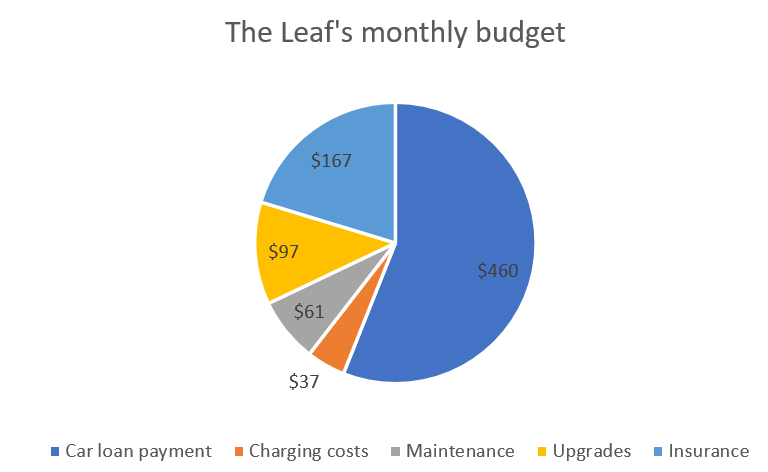
A grand total of $821 per month, most of which is in the form of a “car-payment”, with insurance and maintenance covering most of the remainder. If we exclude the “car-payment” portion as we fully own the Leaf, we are left with $361 per month.
A survey from 2014 reported that the average Canadian spent $437.48 on their car (including insurance, maintenance and eh, gas). This figure falls in-between our monthly expense with and without the car-loan. Consumer reports did a study comparing life-time costs of EV’s with that of gas cars, and indeed they found significant savings with EV’s (source).
In the end, EV’s offer far lower operating costs than gas cars, but are more costly to purchase. For example, a visit to nissan.ca, reveals that the $25 000 I spent on a used 2018 Nissan Leaf would have bought a new Nissan Versa, with about $8 000 left over. How this plays out in your pocket book, largely depends on how you go about buying the EV. As we own our Leaf, seems we are saving $76 per month compared to the average Canadian. Oh and at the same time, reducing our carbon footprint. Not bad eh.
 Electric car adventures
One thought on “EV Economics”