Recently reports of Tesla’s loosing cabin heat in “extreme cold” surfaced. Is this more of a Tesla update thing gone wrong, or is there something more sinister going on here? Not to worry, it seems to be an issue with mostly newer Tesla Model 3/Y’s equipped with a cabin heat-pump following a December software update. Older Tesla Model 3’s and other brands seem to work just fine in the cold. I recently took my Nissan Leaf for a spin on a frosty January morning. I certainly had ample cabin heat, but as expected all that heat cut my range down to about 60-80% of “summertime” range. Pre-heating the cabin using AC power, and or using seat/steering wheel warmers instead of cabin heat helps maximize available winter-range.
Heat pumps are marvels of modern engineering. While electric heaters are very efficient at turning electrical energy into heat, it turns out, you can get the same amount of heat with half to a third less electrical energy by just moving heat around from the outside to the inside. Most cars have an air conditioner (AC) which is actually a heat pump operating in reverse. A reversing valve plus some plumbing parts and you can turn an AC into a heat pump. When it gets cold, ice buildup on the heat pump coils is a common problem in heat pump systems, the comment section of the Tesla Canada article suggests this might well be the problem. Heat pumps can still work in the cold, but you need to run “de-frost” cycles from time to time to keep ice buildup under control. As it gets colder, these “de-frost” cycles reduce the efficiency advantage of a heat-pump, and at some point, its actually more efficient to use electric heaters. It seems that’s exactly what the Nissan Leaf does, which also has a heat pump system on some trims in some markets.
Something tells me that had Tesla done more cold weather testing, they would have discovered this problem and fixed it long before customers (some of which had expired warranty plans) wound up with a broken climate control system. But Tesla being a relatively new automaker may just need some time to develop representative cold weather test procedures. I know from my own experience that finding “intermittent issues with a customer system” is really hard. If twitter is any guide, Tesla is on this, and I am sure they will figure this out and in the future, Tesla EV’s will work just fine in the cold.
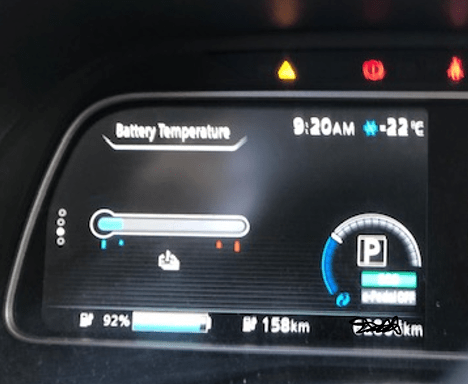
I recently took my leaf for a spin on a cold January morning. The car worked just fine in -22 C temperatures, and I had ample cabin heat. Of note, when full, my guess-o-meter usually reports 270 km or so of available range in the summer. On this cold morning, at 92%, I was getting more like 158 km. This corresponds to about 63% of “summer-time” range. Which is typical. Much of course depends on how cold it is exactly. My one test point at -22 C suggests 63%. Do note there are several tricks you can use to minimize range loss in the cold:
- Use your EV’s pre-heat or pre-condition function to use AC power to warm up the car
- Park in a heated garage
- Use the steering wheel and seat warmers as they use far less electrical energy than the cabin heater
As avid readers of this blog will note, the 2018 Leaf has ample range for wintertime ski-adventures but you do have to plan a little more carefully in the winter.
 Electric car adventures