The environmental benefits of EV’s are greatly enhanced if they can be charged using renewable energy. However, the cheapest energy rates are often at night, not exactly peak solar power production time. All is not lost, the humble laundry-line is a very inexpensive way to increase the share of renewables in your energy mix, in fact my laundry line saves a lot of dryer power. The equivalent of about a third the power I use for my EV. Its also very cost effective project, paying for itself through lower energy costs in less than a year.
A laundry line can be had on the cheap. Rona has one for less than $100 (source), Amazon can do better at $30 (source). As renewables go, this is dirt cheap, compared to say a 6 kW solar system (yours for only $12 260 source). Lets assume we get a laundry line for $100, and supply our own elbow grease for the installation.
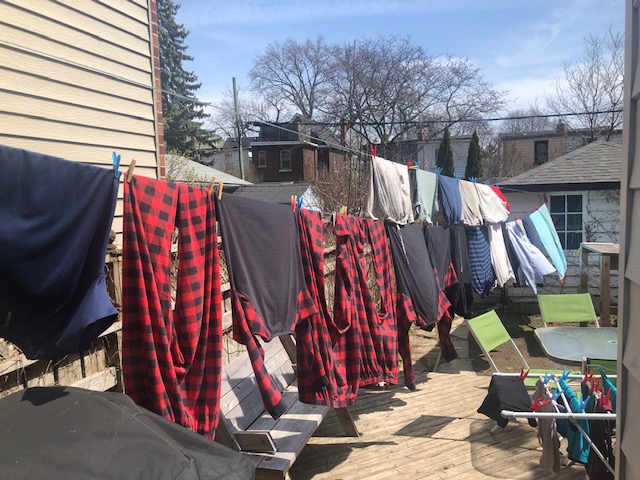
On the other side of the ledger, sits the electricity bill. Our electric dryer uses about 2 kW of electrical energy when in use. Drying a full load according to the household laundry tzar (my wife) takes about 4 hours, and with kids in the house, laundry happens about 3 times per week. So, all-told, that’s about 2 x 4 x 3 = 24 kWh of electricity per week drying our clothes. Toronto Hydro charges anywhere from 12-20 cents per kWh (including transportation, regulatory and HST, source), The exact rate depends on the time of day, with weekends and nights being cheaper. Lets split the difference, and assume 16 cents per kWh, hence our weekly dryer power bill adds up to $3.84 per week.
So, in $100/$3.84/week = 26 weeks, I’ll be in the green with my laundry line project. A 6 month payback is far more cost effective than a residential solar project which has a return on investment period of perhaps 5-15 years (source). To be fair, here in Toronto, ON, the outdoor laundry line is more of a summer thing, so lets stretch the 6 month payback period to a year. Do note that many people dry their clothes indoors, as this provides much needed humidity during the winter months when our central air heating system kicks in (source).
While not directly relevant to EV’s, the laundry line project is a very inexpensive way to increase solar and wind energy. Those 24 kWh of weekly dryer usage add up to about 1.2 MWh on an annual basis, about the same as a trio of 400 W solar panels might produce in a year (source). That 1.2 MWh is a little more than third of our annual EV energy usage (assuming 20 000 km/yr at 6.5 km/kWh), that’s a whole lot of green, certainly for the modest $100 cost.
 Electric car adventures
One thought on “More Wind and Solar energy?”