From 24 kWh in 2011, to 30 kWh in 2017 to 40 in 2018 and 2019 to now either 62 or 40 kWh. Nissan has somehow stopped growing the battery in the leaf. Could it be that 62 kWh is enough? We compare Nissan to a few other brands in the EV market, and also do some analysis on both the utility and the economics of bigger batteries. In practice, there is a limit to how long a human can stay behind the wheel, this limit, along with improving charging infrastructure, puts a cap on how large a battery an EV needs. This is good news for value minded EV shoppers, as the benefit of ever decreasing battery pack costs now starts to deliver significant price reductions, instead of increased capacity for the same cost.
During most of the last decade from 2011 to 2020, EV battery size has increased significantly. Most of this was driven by range, namely the desire to approach 400-500 km of range which matches what most gas cars can do before requiring fueling. From the 150 km or so in the 2011 Nissan Leaf, to the 650 km of the Tesla Model S, range has indeed jumped by leaps and bounds during the last decade or so. As you can see below, it seems progress in this regard has somewhat slowed, with none of my admittedly somewhat random brands showing an increase in battery pack size from 2020 onward.

When we look at the economics, namely cost per kWh of pack capacity, a clear downward trend is seen (source, and source). The orange line shows a fit to a “discount” curve, of about 23% per year, suggesting that over time, on the average, battery pack cost per kWh gets 23% cheaper per year. I suppose shortages and other issues of the post-covid era, may nudge prices upwards in the next few years, cost per kWh of battery capacity is now hovering just above 100 $/kWh. The original Nissan Leaf, with its 24 kWh pack, would therefore cost about $2 400, today, compared to $120 000 back in 2011. Should this trend continue, we can expect the 62 kWh Nissan Leaf Plus pack to cost 620 $ by 2030. This compares to a $4 000-$8 000 cost to purchase an engine for a gas car (source).
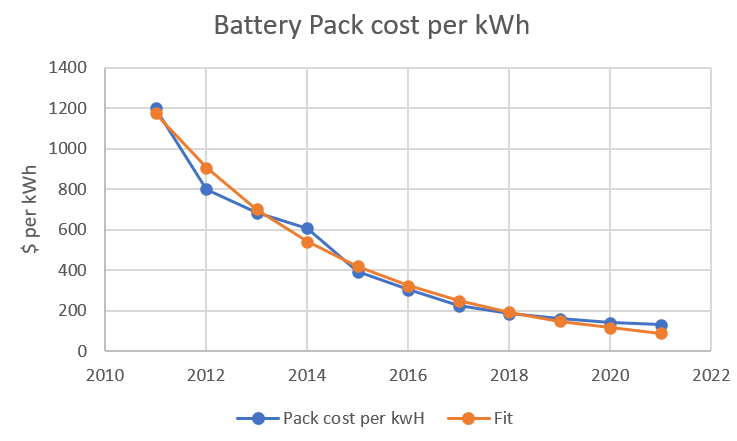
Thus we can expect EVs to gradually become cheaper than Gas cars, something we are getting tantalizingly close to already, with the new Nissan Leaf MSRP of about $25 000 (see this post).
Naturally, if the pack price per kWh continues to fall, one might be tempted to spend this windfall instead on more kWh, bigger packs and more range. Perhaps, but consider how long it would actually take to drive your EV from full to empty. To do this, we need to make a few assumptions. Driving speed, and efficiency. I considered two scenarios, a high efficiency and a fast scenario. For high efficiency I assumed efficiency of 7 km/kWh and a driving speed of 80 km/hr, for fast 5 km/kWh and 110 km/hr.
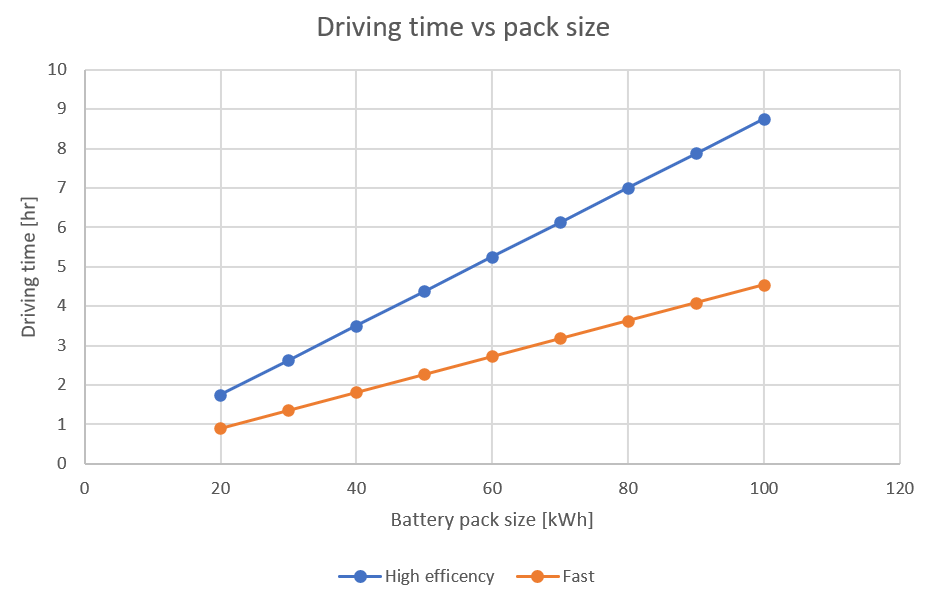
As we can see, even for my 2018 Nissan leaf, under the “fast” scenario, it takes a good two hours and 200 km to drain the pack. A 60 kWh pack in “high-efficiency” scenario gets to empty in 5 hours and 400 km. With improving charging infrastructure, one ought to be able to find a suitable charging station, even under my “fast” scenario in a 2018 Nissan Leaf. On a long road trip, experts recommend a break of at least 15 minutes every two hours (source). Thus I would say, its reasonable to ask if one needs a bigger pack than 60 kWh, after all, why miss out on all the wonderful things between here and there.
 Electric car adventures