Car’s are not the only source of carbon emissions in the transport category. Ferries, trains, aircraft, trucks etc. also generate CO2 emissions. It can make a lot of economic sense to electrify some of them, particularly if the route is short. I recently rode an “plug-in-hybrid” ferry, which operates entirely on electricity for its usual 40 minute crossing. For the passenger, its a very quiet ride, and the improved operating economics result in a slightly lower fare, not to mention a greener conscience. Electrical transmission infrastructure places some constraints on electrification of ferries serving longer routes.
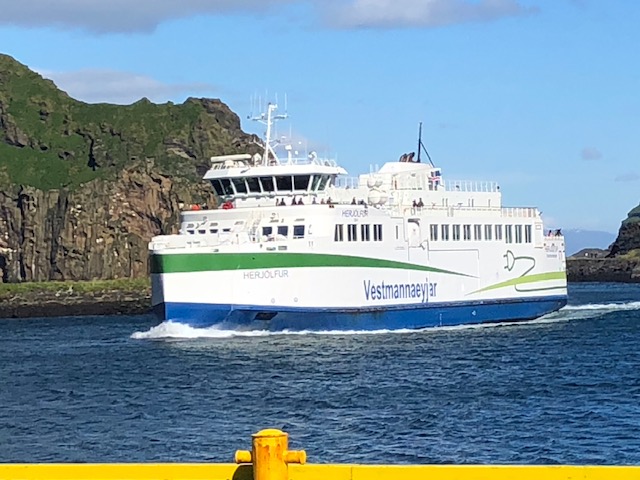
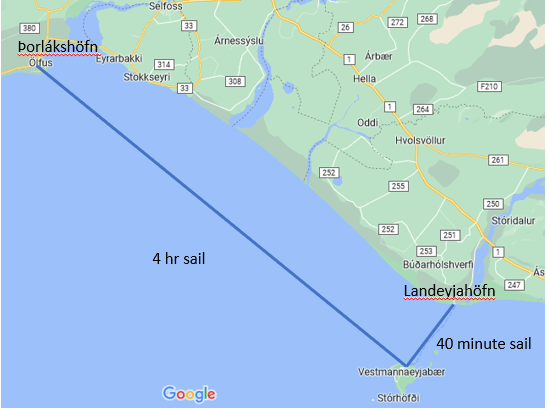
The ferry Herjólfur, operates from Landeyjahöfn to Vestmannaeyjar, usually a 40 minute sail. Staff tells me that usually this can be done on electricity alone, although there is an onboard Diesel generator that can be used once the batteries are empty. On occasion in the winter, weather can close Landeyjahöfn, in which case a longer 4 hour sail is needed to Þorlákshöfn.
Here lies the case for the hybrid, battery capacity to permit a 4 hour sail (with sufficient reserves), might not make sense. Even if that was no problem, there is a limit to how much electricity can be charged during the relatively short 45 minute turn-around time as the ferry is unloaded and loaded for the next sail.
A recent report mentioned that Herjólfur when operating entirely on Diesel, burns approximately 35 000 liters of Diesel per week. Herjólfur makes about 7 round trips per day, seven days a week when sailing between Landeyjahöfn and Vestmannaeyjar. So on a per-sailing basis, operating entirely on Diesel, that’s a little over 350 l of Diesel per one-way crossing. Diesel has an energy content of about 10 kWh per liter, assuming a 40 % Diesel generator efficiency (source), we get an energy consumption of about 1.5 MWh per 40 minute crossing.
From a charging perspective, we would need a 2 MW “charging-station” to upload most of the 1.5 MWh needed during our 45 minute ferry turnaround. This is not so far fetched, the EPA assessment of cruise ship shore power showed plenty of locations offering over 2 MW of electrical power at several docs in the US (source). In fact the port of Los Angles apparently has the capacity for a 40 MW shore power connection.
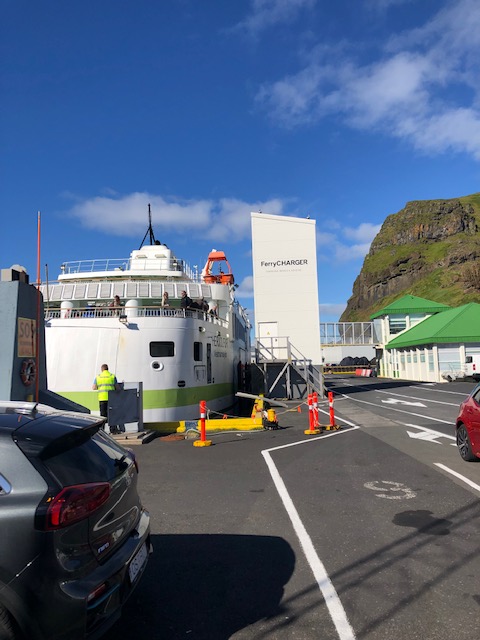
Automation also lends a hand, after all reconnecting and connecting the cabling needed for a 2 MW electrical connection is not a trivial affair. Herjólfur is equipped with an automated system which connects and disconnects the ferry to the mains at either terminal. This helps maximize charging time.
Battery wise, Tesla offers a 3 MWh “mega-pack” that appears to be the size of a shipping container (source). Thus, battery sizes of “a few MWh” certainly seem plausible for a car ferry, especially as comparable Diesel generators rated for “a-few-MW” are not small, in fact the ones for sale on http://www.genpowerusa.com seem to be about the size of a “shipping-container”, which as far as I can determine from my “back of the envelope” math, is comparable in size to the battery required for the 40 minute sail.
Lets briefly look at the longer “bad-weather-winter-route” in case Landeyjahöfn is closed. This is a 4 hour sail, 6 times longer than the shorter 40 minute sail, which Herjólfur can manage on battery power alone. In order to go full-electric, we would need a 8 MWh battery, or say three of Tesla’s Mega-packs. With some clever use of dead-spaces, this might be doable in terms of installation onto Herjólfur, certainly a lot harder than 1.5 MWh battery required for the shorter 40 minute sail.
An overnight charge might allow for one sail from Þorlákshöfn to Vestmannaeyjar, but we would need to substantially upgrade our Ferry-charger to transfer the 8 MWh of electricity required to our Ferry, within our 45 minute turnaround time. One might need perhaps a 10 MW shore power connection, looking at the EPA assessment (source), there are cruise ship terminals in the US that could handle our 10 MW shore power requirement. Granted at such power levels, one also has to ensure that the electrical distribution network is up to snuff, there we might hit a hurdle, as the undersea cable connection from Vestmannaeyjar is about 60 MW ( source), hence our higher power 10 MW Ferry charger would consume a good chunk of its capacity.
 Electric car adventures
One thought on “Big EV, the case for the Electric Ferry”