It turns out that the environmental impact (or at least the carbon footprint) of your EV is a strong function of when you charge it. Electricity comes from a variety of sources, here in Ontario Nuclear provides a significant portion, along with hydro and oil & gas. In terms of carbon emissions, oil & gas is the worst offender, with hydro and nuclear doing much better. Hence, to reduce the environmental impact of my Ontario based EV, charging during the early morning hours, results in the lowest carbon emissions.
Gridwatch Ontario edition provides an overview of what powers Ontario at any given time. As expected, electricity demand varies hugely during the day. Demand is strong during the summer afternoon as people use their air-conditioners to stay cool, also as most of us are sound asleep at 3 am, not much electricity is used at that time. Nuclear is fairly constant source, producing the same amount of power throughout the day, hydro fluctuates a little bit, with Gas absorbing most of the swing in demand.
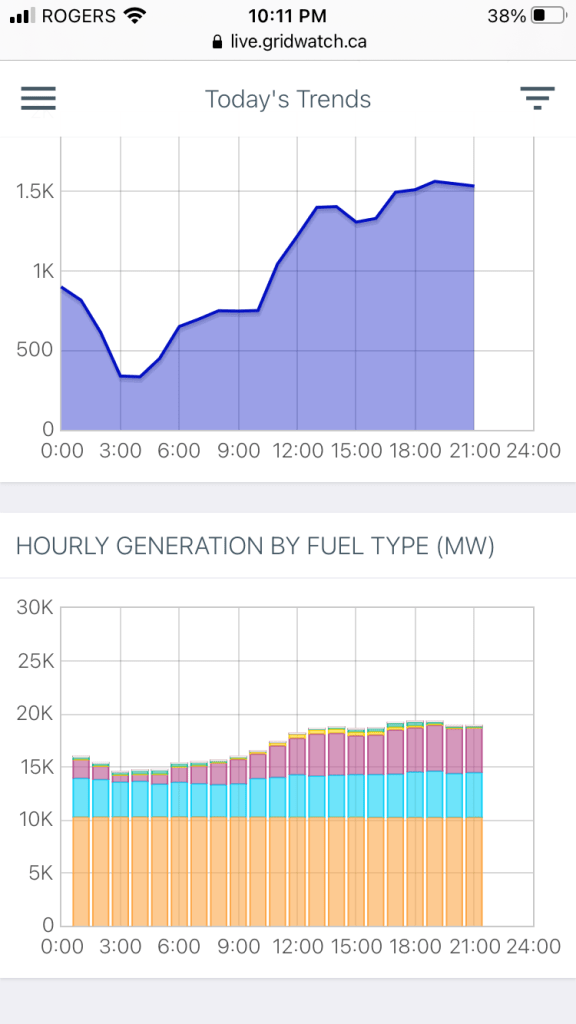
Looking at the gridwatch data, seems charging in the early hours (midnight to 10 am), produces the lowest overall emissions, bottoming out at 400 t/15 000 MWh or 26 g / KWh at 3-4 am, with the highest being about four times that, or 104 g / kWh in the late afternoon.
Here in Toronto, ON, customers typically pay a time-of-use rate, meaning that the cost per kWh of electricity is going to depend on the time of day. Much of this is to persuade customers to distribute their high-power tasks to the off-hours, ensuring a near even power demand. The current rates (summer of 2022) are shown in the table below (source). As far as economics go, 7pm – 7 am is the time to charge your EV.

So, seems the early morning hours are our best bet, from perhaps midnight to 7 am. Thankfully there is no need to be awake to plug your car in at that time, most EVs nowadays offer charging timers that can be set to maximize the benefit to your wallet and the environment.
Smart chargers can take this several steps further. For example, there are chargers on the market that can tap into your solar system (if you have one), and maximize charging speeds when your solar array is shining (source). Not only that, but bidirectional EV chargers are starting to come onto the market, why not use your EV to help the planet, even when its parked, by supplying power when it is needed ( source).
Much as always depends on where you live. California independent systems operator (source) has a similar website where you can see how California’s carbon emissions from electricity generation vary throughout the day. As California gets much more of their electricity from solar, charging during the afternoon might be best in terms of carbon emissions. Icelanders on the other hand, can charge just about any time of the day, as their electricity comes mostly from renewables (source).
 Electric car adventures
3 thoughts on “When should I charge my EV?”