Much ink (digital and otherwise) has been spilled over the impact of electric vehicles on the grid. While its true, EVs do consume electric power, usually from the grid, there is a lot of flexibility in when you charge your EV. In fact, if you follow our recent discussion on when exactly to charge your EV (source) you might do even better. Further we find that making ALL cars in Ontario electric would only increase the load on the grid by 40%, less than the swings we see during the seasons. Given that EVs are likely to gradually replace gas cars over the coming decades all it takes is a little bit of prudent planing, and the lights will stay on just fine.
We begin by estimating the grid load expected if ALL passenger cars became electric. Ontario had about 13M cars on the road back in 2019 (source). On the average, each of these drove about 16 000 km per year (source). So Ontario’s car fleet drives around 256 B km a year.
| Situation | Efficiency |
| Winter driving, roofbox installed, freeway speed +, heater blasting … | 4 km/kWh |
| Hyper-miling along a lonely 200 km road through Northern Ontario with no charging in sight | 9 km/kWh |
| Typical city errand | 7 km/kWh |
| Tesla model 3 standard range plus range test data (source) | 6.7 km/kWh |
| Chevy bolt, range test data (source) | 5.6 km/kWh |
| Hyundai Kona, range test data (source) | 5.7 km/kWh |
| F150 Platinum, range test data (source) | 3.5 km/kWh |
Next we need to assume an average efficiency number. The table above outlines a few situations and the resulting efficiency numbers. About half is from my own adventures discussed in this blog, with the other half sourced around the web. We settle on a 5 km/kWh as our fleet average.
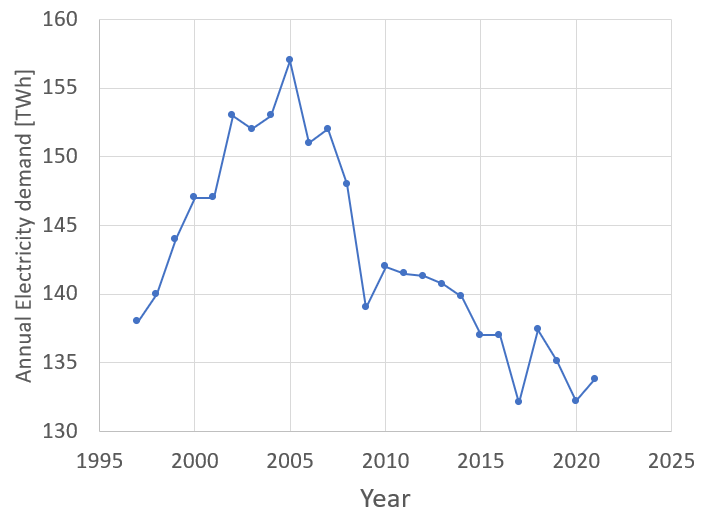
So, our hypothetical 256 B km per year for Ontario’s car fleet, would then consume about 52 TWh per year. What are we asking the grid to do here? In 2021, Ontario consumed about 134 TWh per year (see below), so if every car went electric, right this nanosecond! we can expect total demand to increase by about 40 %. If we are careful about when we charge, I think we might manage an EV transition of “right this nanosecond”. Somehow back in 2007, an all time record summer demand was 27 GW, compared to a 15 GW demand on a fall afternoon in 2022 (source), that’s a 55% difference, more than our 40% increase.
We might also dig deeper for those 52 TWh. Pickering nuclear generating station generated about 26 TWh in 2021 (source). Pickering is scheduled to close in 2026, so there might be some very low hanging fruit in our quest for low carbon electrons. Better still, Ontario wasted 7 TWh in clean energy in 2020 (source), that might have charged a few EV’s.
I charge my car once a week or so on the average, assuming Im not planning a trip or on the road in need of a fast charge, thus most of the time, Im happy to help out the grid. When a heatwave struck California (source), EV owners were asked to limit charging between 4-9 pm. I’m happy to oblige, after all, in California, its cheaper anyways to charge after 9 pm.
Why not go further, smart charging is a wonderful compliment to renewables, I am quite keen to sign up for a variable power rate plan for my car charger. Say when the wind is blowing I can charge my car at the full 6.6 kW power level that it supports, when it is not, 2 kW is enough to get me through tomorrow.
The transition from gas to electric vehicles is likely to take a bit longer than right this nanosecond. Most news sources suggest a gradual increase in new EV sales from the 5% or so now, to 100% in perhaps 2035. It would then be another 15-20 years for existing gas cars to reach retirement, giving us until about 2050. Plenty of time to engineer in sensible solutions to keep our EV’s fully charged, and the lights on. In fact, in a recent forecast, from the independent electricity systems operator in Ontario, EV’s are a fairly modest addition to future energy growth in the coming decades.
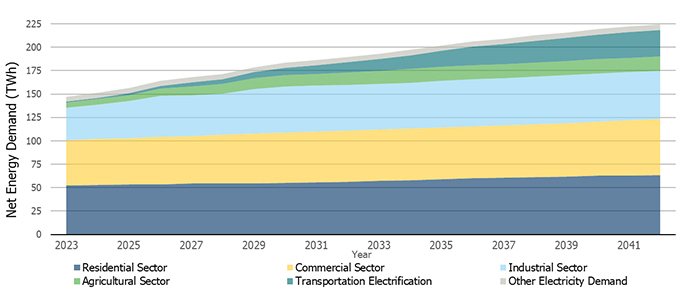
The future is always in motion. Who knows, some smart cookie might find a much more efficient air conditioner, residential solar might migrate from early adopters to mainstream (see source), rooftop wind is becoming more attractive and so on. Looking at historical electricity demand in Ontario we see a steady increase in electricity demand until about 2005, since then demand has fallen from 155 TWh to about 135 TWh last year. The humble light bulb has undergone a tremendous efficiency transformation from 5 % efficient to 70 % efficient in just a few decades (source). Air conditioners, freezers, computers and all sorts of appliances are becoming more and more efficient requiring less and less electricity to operate. Thus, we might not need to find 52 TWh for our future EV fleet at all, it might simply be smart usage of surplus green energy.
 Electric car adventures
One thought on “Will EVs kill Ontario’s power grid?”