As extensively discussed, charging availability (or lack there of) is a big concern amongst EV shoppers, less known, is that a similar fate might be in store for gas-cars. According to industry reports, the number of gas stations is dropping, particularly in large metro-areas as developers eye gas stations for their next condo project. For example, here in Toronto, ON, there are now more charging stations than gas stations (see this post). This trend may continue as charging stations are being installed all over the place at a much more modest cost. We discuss some of the forces behind this trend, and some of their impacts on driving in general.
Near where I live, a gas station was torn down recently to make way for a development related to the new Ontario line. This seems to be a growing trend, with more and more gas stations being re-developed in urban areas. Several factors drive this trend: Land for development is scarce in major cities, selling gas is a marginal business and overall gas-sales appear to have peaked.

Lets begin with land value. According to a recent https://blog.remax.ca/greater-toronto-housing-market-report/ report from ReMax a real estate brokerage, Greather Toronto housing prices have on the average climbed 453 % over the last 25 years. These days the average detached home retails for over 1M $. The former Eagle gas station near Pape and Cosburn might have had 10 or so houses, thus the land value could be around 10 M$ alone. That is a lot of money to a business that might generate a small fraction of that in profits. The price might be much higher for a gas station located closer to downtown, rumors suggest a (former) gas station on Church street went for as much 73 M$ (source, and source).
Selling gas through the ages has been a marginal business. But one that generates a lot of traffic, which in turn creates opportunities for other more profitable business. There is a reason most gas stations also double as convenience stores, and for a small fee, you can inflate your tires, or perhaps do some maintenance. Margins on gas can be as little as a percent, while the fountain soda can yield 800% margins (source).
The future of gasoline sales is difficult to predict with much accuracy. While its true, less efficient SUVs now outsell more efficient passenger cars, the hottest thing these days seems to be the crossover which is smaller than a “mid-size” SUV. Further, engines keep getting better at squeezing energy out of gasoline. And of course, electric car sales are increasing, and those use no gasoline at all. How these trends will play out remains hard to predict, but it seems plausible that “peak-gas” is behind us.
Looking at gasoline sales over the last 25 years or so does offer some hints of a “stalling-market”. Sales both in dollars and liters, climbed steadily since 1993, yet have leveled of around 2017 or so, and declined slightly since then. I did not include any data from 2020 and onwards, as the COVID pandemic undoubtedly caused much chaos is gasoline markets as everywhere else. While it is too early to tell, “peak-gas” appears to have been in 2018 (by value), or 2017 (by volume).
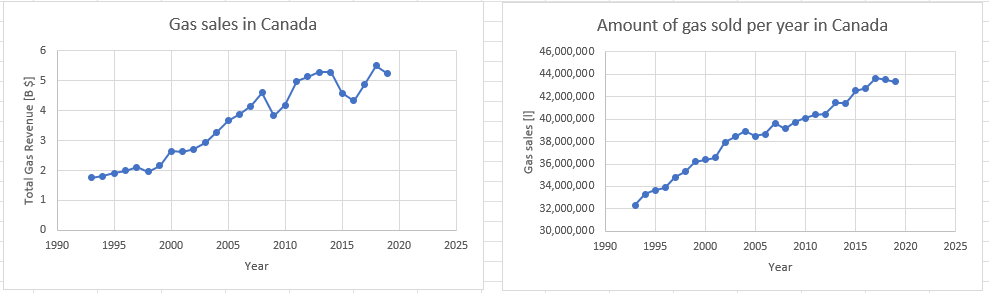
Taken together, I have gained new understanding of why the owners of Eagle self-serve decided to sell. Faced with a very marginal business, one whose sales might be in decline, and a very tempting buy-out offer, I might sell too. The US seems to have lost about 40% of its gas stations in the last 25 years (source).
Thus, if you drive a gas car, finding gas is starting to get ever so slightly harder. Perhaps not quite to a point where as in 1910, you were left scrounging for “5-gallon-tins” (source). This might be more apparent in rural regions, driving 100 km or so to the nearest gas station, makes electric cars look pretty good, where you can simply charge at home, this might explain the surprising growth of electric car sales in rural America. Mississippi, which has not voted for a Democratic president since Roosevelt, recently recorded the strongest plug-in sales growth of any state (source).
Of course, there is nothing stopping gas stations from installing EV chargers. Many in fact have done so, where I live, Petro Canada has operated the electric-highway for three years now, and Shell recently started expanding the Shell Recharge EV charger network. This might be a growing trend, in particular given the modest cost of installing a EV charging station. A few “tens-of-thousands” of dollars gets you a few L2 charging stations, while a few “hundreds-of-thousands” would get you a L3 DC fast charging station installed. These amounts are far less than what is reported for adding a gas-pump (source and source). Plus an EV driver might have half an hour to kill while the vehicle charges, perhaps Ill have a fountain soda…
Interestingly, given the modest cost of installing EV chargers, we might see convenience stores becoming EV charging stations. Indeed, I have charged at plenty of Tims and grocery stores.
Thus it seems quite possible that gas car owners might have a harder time sourcing gas as opposed to EV owners accessing charging. That might be years in the future, but I suspect that time will come.
 Electric car adventures