As winter sets in, a youtube video surfaced of people testing out the Tesla Model 3 cabin heat system on a very cold day, getting little if any cabin heat as the car sat there (source). Well, I hopped in my Leaf on a very cold day, and sure enough I had plenty of heat. What explains the difference? Turns out heat pumps struggle in extreme cold, in particular if there is no excess heat they can tap into. Resistive PTC heaters on the other hand work just fine in the cold, albeit 5-10% of battery electrons are diverted to cabin heat.
A frosty forecast of -17 C for Toronto was the ideal setting for some fact checking. I jumped into my Nissan Leaf, which I keep in an unheated garage. My Leaf was reporting an outside temperature of -11 C, a little warmer than the forecast. Using an IR temperature meter, the cabin at the start was the same, -11 C. I started the car, asked for lots of heat, which the car delivered in spades. Just a minute later, the cabin sat at 0 C and climbing (our youtubbers got there in 20 minutes). The heated steering wheel and seat, added loads more heat and I felt quite comfortable.
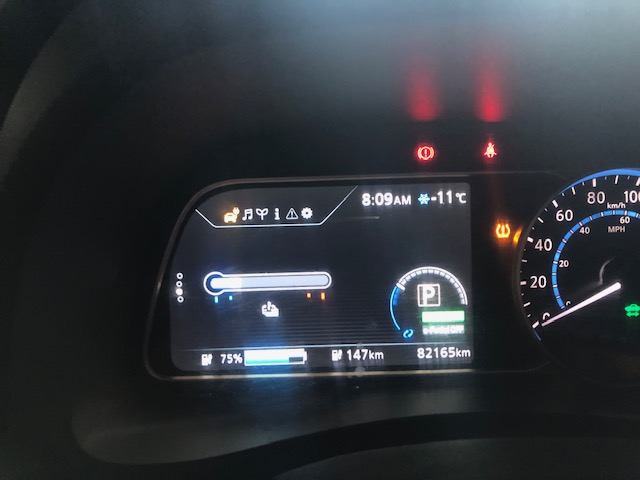
So why did the Colorado based youtubers stay so cold? There are some technical differences between their Tesla Model 3s, and my Nissan Leaf. In fact the comments suggested some settings adjustments would have kept our brave youtubers much warmer. Also, it was a little colder there, (about -28 C, vs -11 C for me).
I suspect Tesla (and some other EVs) also take advantage of waste-heat that is generated by the electric motor and associated electronics. While electric motors, inverters etc. are very efficient, combined losses might plausibly be 5%. On a 100 kW motor/power train operating at full power, that’s about 5 kW of heat that could be used. But alas, our youtubers Tesla sat still, hence that crucial 5kW of potential heat may not have been available to them.
Heating efficiency per say is only a means to an end, what people generally want from their EV is range. So how much range loss are we talking about here? Put another way, how much energy does my Leaf’s 6 kW PTC heater use compared to driving. Suppose were driving around at 90 km/h, efficiency is 5 km/kWh, our drive-train needs 18 kW. Our drive train thus uses about 75% of supplied battery power, vs 25% for the heater. Usually I find the Leaf pulls lots of power at first but then settles into a 1-2 kW power draw for cabin heat, which would be 5-10 % of overall power draw. Not overly crucial in the big scheme of things.
The next day it got even colder, and we were planning a ski-trip. Never-fear, I simply programmed the climate system to pre-heat the car which was very warm when we left for the hill.
 Electric car adventures