There is no denying it, Tesla has had quite the impact on the EV world. These days the Tesla Model Y outsells the Tesla Model 3, at least in North America. So I jumped at the chance to take one for a spin. Tesla’s roots as a sports-car maker are evident in the driving experience, yet the Model Y retains the roominess you would expect from a crossover. Do note that Tesla’s user interface is very different compared to other cars, thus there is a learning curve and I did struggle with some basic tasks such as turning on the wind-screen defogger. Of course, it should be noted that you could almost buy two Nissan Leafs for the price of one Tesla Model Y.
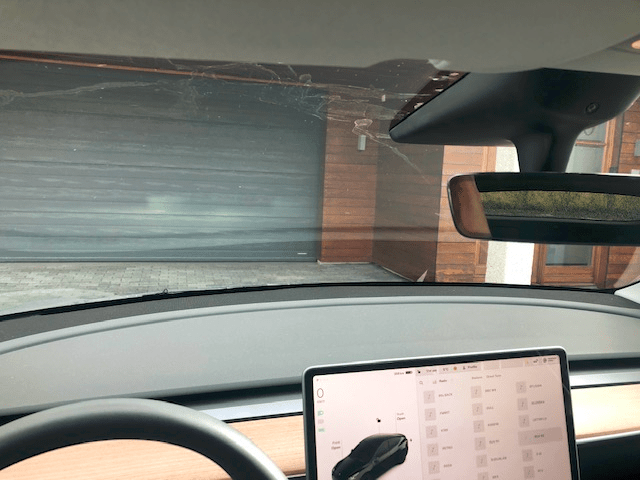
Having driven the Model 3, I noticed a lot of similarities. The interior and controls look similarly minimalist. The rear view mirror feels similar, but the view out the back through it is quite small, owning to the sloping roofline. This caused me some discomfort while driving, as I was not able to figure out how to turn on surround view while driving, so without that mirror, not sure how I would go about monitoring traffic behind me, do leave a comment below if you know how, I would be curious.
Update: Turns out there is a button on the touch screen to view the rear view camera at any time (see this tutorial).
The backseat offers a lot of space, at 6 ft 4 inches, I felt quite comfortable back there with sufficient space to enjoy on a road trip. The trunk has lots of space, at one point we put two coffee tables, some chairs and a coffee maker back there without any issues. You can also remove some of the trunk flooring panels to squeeze more stuff in. Some versions of the Model Y offer an extra row you can put in the trunk to seat two more (small) passengers (source). The version I drove does not have this, some shopping on Tesla’s Canadian website shows at the time of this writing (spring 2023) the feature is available for the lower priced long-range model Y.
Tesla, as do many other brands, offers a guess-o-meter giving you an estimate of how far it can go before running out of juice. Also, as do many other cars, the guess-o-meter has some behavior psychology in it. It seems for example that there is a 30-40 km buffer “below zero” (source). This is presumably to keep you from discharging the battery too far during routine operations. I found the guess-o-meter a little optimistic. As with most Tesla’s, there is a plethora of various features on the touch-screen menu. Climate control for example was set for a steamy 20C, on a fairly cool day (temperatures were just above 0C).
Range seemed a little short of the advertised 541 km range (source). While that is not unusual for EV’s, as many factors influence range, such as speed, climate control, weather, and driving style. For example, one started with 75% of the battery for a 240 km drive, the guess-o-meter reported 320 km remaining, so plenty right? Well, they make it, but only with 3% remaining on the battery. I suspect a more savy user might have found ways to squeeze more juice out of the pack (see for example this).
I drove the Tesla Model Y in Europe, where the charging landscape is different than in North-America. Briefly, the EU had the foresight to insist that all electric cars have the same charging inlet, CCS-type2. This means that Tesla’s supercharging network is in effect open to all other EVs and vice versa. While Tesla does install superchargers in Europe, where I drove, they were a relatively minor player (plughsare shows about 90 charging stations in the country I drove the Model Y, about 8 of these were Tesla Superchargers). Compared to North America, where Tesla superchargers are a huge plus for Tesla’s EV’s and use their proprietary charging inlet, although the new “magic-dock” is changing that (source).
 Electric car adventures