Recently, I wrote a post of rooftop solar here in Toronto. Briefly, as I only spend 100$ per month on electricity, its tough to justify investing tens of thousands of dollars on a solar system to reduce my electricity bill. But seen from another perspective, how do Ontarians meet our energy challenges into the future? The situation is very different. Solar and batteries are quite competitive as it turns out compared to recent large Canadian power projects. Indeed, we find rooftop solar to be competitive on a per kW generated basis, although as the sun does not shine 24/7, its yearly generation statistics are less favorable.
Why is power in Ontario so cheap? Well, we have seen a steady reduction in overall energy demand in the province, yearly demand went from 152 TWh/yr in 2007 to 137.6 TWh/yr in 2022 (source). This is perhaps the primary reason, Coal power stations in Ontario closed, with the last station going off line in 2014 (source). At the same time, renewables have only increased so there are more electrons being generated than Ontario needs right now.
But, alas that might be coming to an end. Pickering Nuclear power station is on life-support, Tens of billions of dollars need to be spent on refurbishment for continual operation into the 2030s. Its 20 TWh annual output will need to be replaced somehow. Further, while consumption in 2022 was less than 2007, we are seeing a slight uptick in Ontario’s energy usage in the last few years, with Ontario electricity demand expected to grow at 1.7% per year until the 2040s (source).
So where are those electrons going to come from? Looking to the past can provide some insights. Lets look at past projects, and see how they compare to rooftop solar.
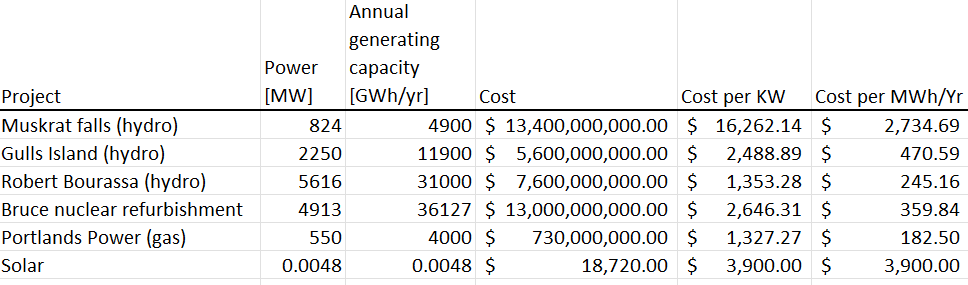
As we can see, using the literature value of 3.9$ per W of generation for rooftop solar (https://www.energyhub.org/ source), on a per kW generating capacity basis, solar is quite competitive. Not the cheapest, but certainly quite competitive. As discussed in a prior a post, I might squeeze in a 4.8 kW solar system on my roof, at an estimated cost of $18 720, this system might generate perhaps 4.8 MWh/yr. Granted, increasing our reliance on solar, might mean additional investments in battery systems. For my house, I would need to add perhaps $10 000 (source) to the above figures.
Muskrat falls is quite the outlier in the table above. Some of this, to put it bluntly, is owning to various rookie mistakes, but the costs for the Muskrat falls project do include the cost of the transmission infrastructure from Muskrat falls to St. Jhons and Nova Scotia, something the other hydro projects do not include ( source). This is why the cost figures for Gull Island project are much more attractive, the idea is to leverage existing transmission infrastructure (source and source) although links would need to be beefed up to handle the additional capacity, such upgrades are much cheaper than building transmission lines from scratch.
Wikipedia also furnished figures for Robert Burasa generating station, and Bruce power nuclear refurbishment projects (source and source), in both cases, existing transmission infrastructure could largely be used. Transmission infrastructure can be quite expensive, figures into the millions of dollars per km have been seen (source). Hydro and nuclear plants are often located far from inhabited areas, hence transmission lines can easily add billions of dollars to the budget.
While capital costs for thermal power plants like Portlands energy center which runs on gas (source), are lower, fuel costs are not included, which can be quite substantial perhaps half of overall operating costs (source).
Given these figures, I feel our policy makers can not afford to ignore rooftop solar. Cost effectiveness when it comes to power generation is generally at its best when you use what you got, rooftop solar certainly qualifies there. Indeed, incentives are on the table in many places including Toronto. Further, research has shown solar panels might increase the price of your home (source), perhaps by 4%. Given the state of Toronto’s housing market, that 4% alone might pay for the system.
 Electric car adventures
One thought on “Rooftop solar, is it a better idea than I thought?”