Much ink has been spilled over the state of Ontario’s Electricity grid, some fear a near total collapse as EVs become more common. As always, the truth is more nuanced, during certain times, Ontario’s grid is under strain, while at others, ample power is available. A home battery system can help. The idea here is to use the battery instead of grid power during high demand, recharging when ample low carbon power is available. Home battery systems can run into the tens of thousands of dollars, being on a budget, I figured Id start with an Amazon impulse purchase (an Echo Flo Delta 2, which retails for about 1k CAD). We find that while the Eco-Flo Delta 2’s 1 kWh capacity is not quite enough. But we need just a little more, 2.2 kWh to get me through the on-peak hours on the average day. However we would need a much higher discharge rate, 10 kW or so, to power the entire house.
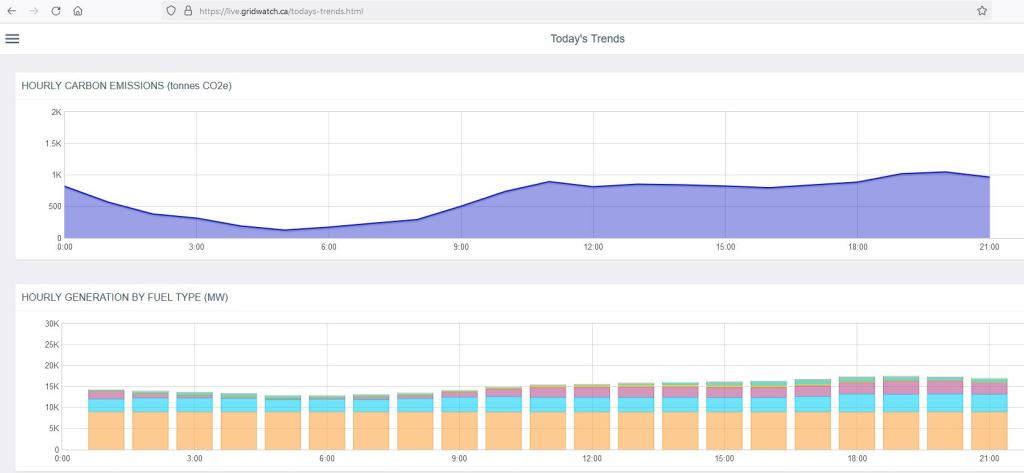
The goal here is to take advantage of lower priced, and lower carbon electricity that’s available during the dead of night. Looking at a typical day from gridwatch.ca (see below), we see that electricity produced between say 2 am and 6 am, is almost exclusively nuclear and hydro, two zero carbon sources. Recently Ontario announced a ultra-low-overnight (ULO) pricing plan, where you are only charged 2.5c/kWh during the night, but 25 c/kWh during the afternoon peak (4-9 pm), providing an economic incentive as well.
A home battery system is one way to solve this. The costs are quite high, the Tesla Powerwall for example retails for perhaps $8 500 (source), installation might add another few thousand, putting the total cost in the tens of thousands of dollars. A Powerwall has about 13 kWh of capacity, and can discharge at 5 kW, which might suffice for select loads in my house.
The EchoFlo Delta 2, can power most small appliances, including my air-fryer. It has a capacity of about 1 kWh, and can discharge up to 2 kW. Below, it can be seen in action powering my air-fryer below. You can get one for $1300 and no installation is necessary (source). Ive been experimenting with it for a few weeks now, and it does work as advertised. When full, it will do my french fries (barely) in the air-fryer, pulling 1.5kW, for 40 minutes. It also will run the kettle, the coffee maker, and my camping induction stove top. As its discharge capacity is 2kW, I can typically only run one of these at a time, but with some planning, a meal can be made.

Looking at my power bill, on the average, my on-peak usage during the time Ive had the Echo-Flo, is only about 2.2 kWh. Some of this is because we have already shifted our major energy hogs outside the peak time (4-9 pm on weekdays). The car is on a charge timer set to charge at the cheapest time, 11 pm to 7 am. Our programmable thermostat is similarly set to avoid heating/cooling during peak demand. Also, we typically use either the clothes line outside or overnight drying with our dryer, with the dishwasher set on a timer. The table below summarizes my power bill:
| Time-period | Rate [c/Kwh] | Average daily usage [kWh] | Total Power usage [kWh] | % |
| ULO overnight (11 pm-7 am) | 3 | 7.9 | 302 | 48 |
| Weekend rate (7 am – 11 pm) | 8 | 9.3 | 103 | 17 |
| Weekday rate (7 am – 4pm and 9pm-11 pm) | 11 | 11.7 | 155 | 25 |
| Peak rate (weekdays 4pm-9 pm) | 25 | 2.2 | 61 | 10 |
As you can see, we would only need 2.2 kWh more to shift the remaining average daily usage to the cheaper overnight rate. Perhaps all I need is another strategically placed eco-flow or two to eliminate most of my peak rate usage. That certainly would be a lot cheaper than installing a whole house battery, although less convenient as my stove for example would need a 240V capable system.
What Id need in terms of discharge for a whole house battery is a good question. Looking at my breaker board, the only large load I would like to have on a battery is the stove, as making dinner requires a good stove. My stove is on a 240V, 40A = 10kW circuit. Which strikes me as a decent specification for a whole house battery. You would need two PowerWalls to meet that specification, putting the costs well into 20-30k range.
Thus economically, an extra Echo-Flow or two placed strategically around the house make a lot of sense. At the time of this writing (summer 2023), there is for example not an easy “charge only during 11pm-7am” option. I get around this by using a slow rate of charge, and just plugging in late at night, but something more convenient would be helpful.
 Electric car adventures
One thought on “Experiments in Peak Shifting”