This is something that comes up when shopping for a car. “I need a big big big SUV that can take me and my family ski-gear and all, on a road trip to say Banff AB”. Such a requirement naturally sends one towards a large gas guzzling SUV, while there are larger EVs like Ford 150 Lightning, Rivian RT1 and others on the market, for reasons we will discuss, long charging stops are a reality when driving through rural areas. So while flying certainly adds a lot to your carbon footprint. Perhaps overall it is more sensible than driving around a big behemoth for the 2 weeks you actually need it, plus flying to Calgary is a lot faster than driving.
Why the long charging stops for large EVs? Most charging stations are limited to a 50 kW output. Assuming consumption of say 2 km/kWh for a large EV, that’s a charging speed of 100 km/hr. My 2018 Nissan Leaf for comparison, gets 6 km/kWh, resulting in a much more reasonable 300 km/hr charging speed. This matter, suppose you want enough charge into your EV to drive another 200 km (that’s about 2 hours of driving at 100 km/hr), my Leaf gets enough energy in perhaps 40 minutes, while our larger EV, lower efficiency EV, needs 2 hours. To balance the efficiency loss, we would actually need to charge our larger EV at 150 kW. Granted, more and more high power charging stations are opening up, but for now, my quick plugshare survey, suggests there are 2 x 50 kW stations for every 150 kW+ station (excluding Tesla superchargers makes it more like 4 x 50 kW stations for every 150 kW+ station).
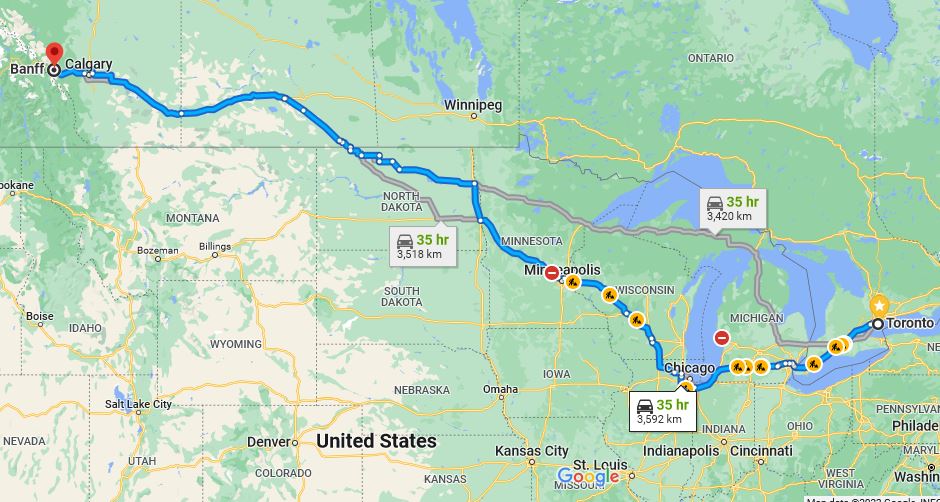
Even if one could drive nonstop to Banff, AB, it would take several days at least. Its over 3000 km! Driving non-stop with only the minimum in terms of customs delays (going through the US shaves a few hundred km of the journey), gets you a 35 hr drive time, hardly practical anyways. If you are a commercial truck driver, you are limited to no more than 14 hours driving in a day (source). Therefore, its a thee day odyssey even without charging stops.
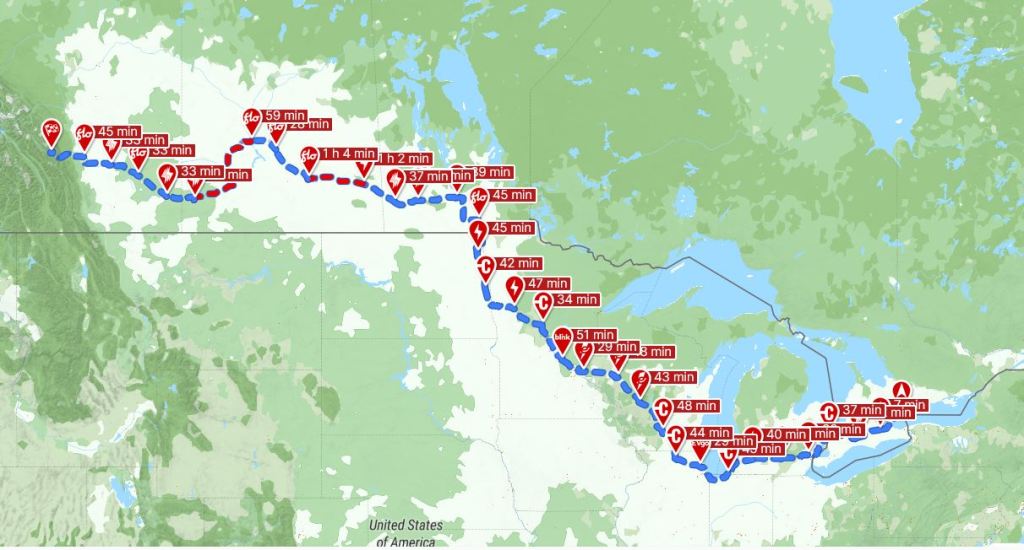
Interestingly enough a better routeplanner (https://abetterrouteplanner.com/) does almost succeed in finding a 40 hour route for my 2018 Nissan Leaf from Toronto to Alberta. There are some routing issues while going through Saskatchewan, but I suspect with clever planning on where you spend the night (and charging overnight from a wall plug while you snooze), something could be managed. Perhaps it would be 4 days vs the 3 day reference journey.
No matter what you do, driving to Banff and back is going to take longer than the week or so we have of vacation time. Cost wise, flying is going to be cheaper, and if it means you can live with a lower range, smaller EV, perhaps overall the greener choice. We certainly had a lot of fun in the mountains, and you certainly can too.

 Electric car adventures