Recently Ontario offered electricity customers in select markets, a new ultra-low overnight electricity rate. On the upside, you pay a very low overnight rate (2.5 c/kWh), on the downside, peak rates are much higher (25 c/kWh). I decided to switch, although some of my neighbors were skeptical, mostly as well, people like to sleep during the night. Turns out there are savings to be had, mostly by shifting energy intense appliances to run overnight, we saved about 6% on our bill, despite using a 9% more electricity than in the previous month.
Lets look at my current electricity bill, the first one after I switched to the new ULO rate. This bill is about 6% lower, despite using 9% more power than last month. The table below shows how my usage went proportionally over the different usage windows:
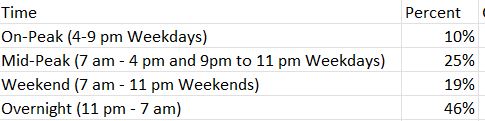
Seems I managed to shift half my usage to the overnight hours. Not bad. Lets look at some of the things we did to shift usage.
- The EV: This one was easy, our Leaf comes with a charging timer function that lets you set the charging window, we simply entered 11 pm to 7 am. Most EVs have this function, more in this post.
- HVAC: If you have not already, get a programmable thermostat. This wonder lets you vary the set temperature during the day. There is no need to cool or heat an empty house if everyone is at work or school. This also allows us to automatically shift our usage. We can stiffly AC the house at night, while opening the windows during the day. It does help that both of us have offices in our basement which stay’s cool during the day. During the winter, we start warming the house a little bit before 7 am, to leverage the cheaper overnight rates and get the house toasty for the morning.
- Dishwasher: Our dishwasher has a delay function, which we use to push the dish-washing into the overnight hours.
- Laundry: We use the clothesline as much as possible. When its rainy or cold, we run our dryer overnight (More on this here).
- Peak shifting: I do have a small eco-flow Delta 2 battery that lets me run the air-fryer on battery power. Its not always big enough to make dinner, but often it is enough.
As you can see, there are ample ways to shift usage to the cheaper overnight rate, and with it save yourself a few dollars, and help keep those peaker gas plants off.
A word on fire safety. While lots of appliances can run safely at night, an appliance fire in the night has the potential to remain undiscovered longer than during the day. Its a good idea, to ensure your smoke detectors are in good working order, and to clean lint out of your dryer on a regular basis, both the lint trap as well as the exhaust piping.
 Electric car adventures