The North American Charging Standard (NACS), formerly known as the Tesla plug, is a DC fast charging system. Its one of three active fast charging systems in North America at the moment, (the other two being CCS and CHADEMO). Recently, Ford, GM and Polestar decided to equip their vehicles with a NACS connector for fast charging, which presumably in a few years will allow more EVs to use that prestigious Tesla supercharging network. We explore the reasoning behind this, as the Tesla supercharging network is much easier to use (for Tesla cars anyways), its also a very deep network, a supercharging station will have lots more stalls than charging stations from other networks. We do find that supercharging speed is less than what other networks achieve, something that might bother drivers of large EVs such as pickup trucks.
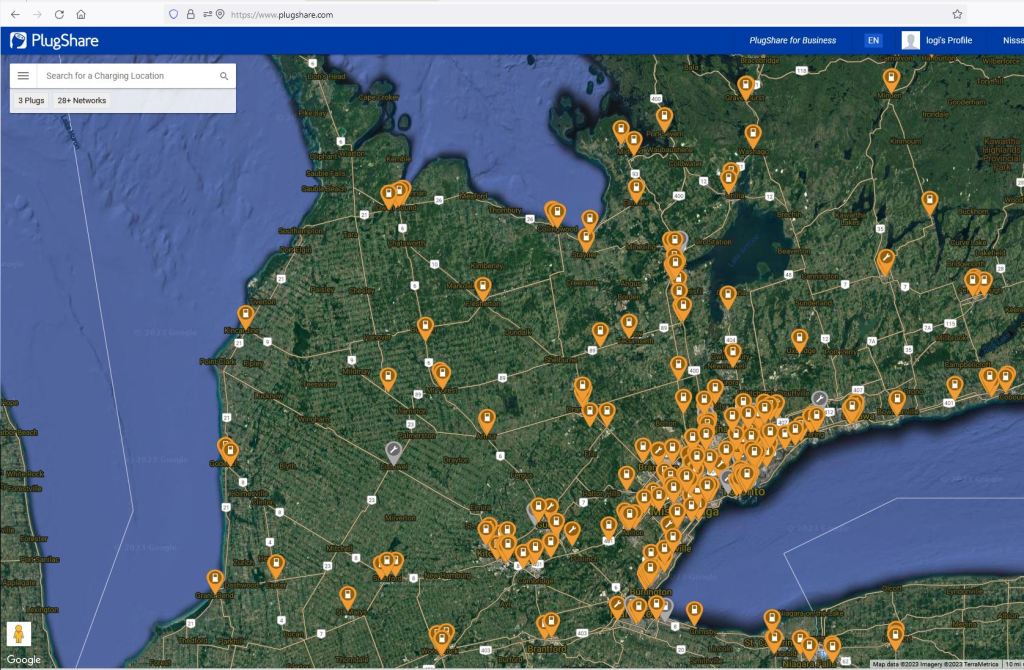
At first glance, I must say I am somewhat confused over why automakers would rush to NACS. Looking at fast charging stations on plugshare, only 26 of the 276 fast chargers near Toronto ON are Tesla superchargers. Why go through the trouble of changing charging inlets? Well, as it turns out, there are several compelling reasons:
- The supercharger network, while not particularly wide, is very deep. Take Wawa, ON as an example. There is a supercharger station there with 6 stalls! Compare that to nearby Petro Canada, which has only 2, only one of which is working according to Plugshare at the time of this writing (June 2023, source)
- The supercharging network is well maintained, with excellent uptime statistics (source).
- Superchargers can hit 250 kW, while there are combined charging standard (CCS) charging stations that can go to 350 kW, most DC fast charging stations are 50 kW stations. If I filter for 200 kW + stations, the situation is very different, we only have another 20 or so non-Tesla stations that can hit 200 kW near Toronto, about the same as the number of superchargers.
- NACS cables are much more compact than CCS or Chademo, making them easier to handle.
- Superchargers handle payments seamlessly. Assuming everything works, all you have to do is plug in your car, and you are charging right away. No need to fumble with apps, RF ID cards etc.
That last bit about payments, its arguably the problem with the non-Tesla charging network. In a previous post, I wrote about my experience helping an elderly couple use a non-Tesla charging station. As is typical, a new app had to be downloaded, payment information entered, and finally they could start the charge. Their issue was really all about the payment side, which is very different to using a gas pump, where I simply tap my credit card.
Recently, Tesla started to open up their supercharging network to other brands. Here in North America, they use an interesting integrated adapter to allow CCS cars to charge. But alas to use this, requires another EV app, which is there to handle payment, so back to our fumbling problem…
The other two supercharger advantages (depth, and speed) are very relevant. Having lots of stalls available means that even if one is broken, you need not worry, try another one chances are it will work for you. Many non-Tesla charging stations are just one stall stations, so if it does not work, you might have to re-route your trip.
Speed is very helpful, particularly for large trucks. As discussed in a previous post, a large F150 pickup needs 150 kW just to stay even with my 50 kW 2018 Nissan Leaf, as its efficiency numbers are only a 1/3 of what I get. If you want to push charging stops to less than 30 minutes, faster charging becomes essential, with 350 kW needed in order to keep a F150 charging stop to about 15 minutes. Oddly enough, current V4 superchargers support 250 kW maximum, while there are CCS stations that can hit 350 kW (source, and source).
So, will NACS stick? Only time will tell, at the moment, its charging speed is a little slow, but I do suspect future versions of the supercharger will figure out how to increase supercharging speeds. After all, the Tesla semi, apparently can hit 1MW charging speeds.
 Electric car adventures
One thought on “Whats with the NACS fever?”