Mitsubishi continues the evolution of the Outlander with a slightly smaller Eclipse cross. While there is ample space in the interior (my 6’4″ frame fit just fine in the back seat), the boot is slightly smaller. As with the Outlander PHEV, the battery pack is located in the boot, which includes the 12V battery. We had plenty of space for my family of four, plus some luggage on a road trip in Europe. Sadly, the Eclipse Cross is not available in North America.
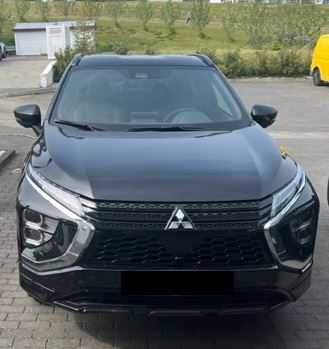
There are many similarities between the Outlander and the Eclipse Cross. The Eclipse Cross is billed as slightly smaller (and according to Mitsubishi.ca, the petrol versions are priced about $4 000 apart). This makes the Eclipse cross lighter, and slightly more efficient, which gives it a 45 km Electric rating (source), a bit more than the older Outlander I drove earlier (source). During our time with it, we felt these range improvements translated into the real world.
Other evolutionary changes, we did notice a slightly improved performance, and the electric range does seem a little better than the Outlander. We did wind up driving up a decently steep long hill on our road-trip. With the Outlander, once the battery drained, we could not keep up with the speed limit. The Eclipse cross had no problems keeping to the speed limit, although, there was a slight but noticeable increase in engine noise once the battery drained. There is also a small outlet in the trunk that could be used to power small electronics (1500W max load).
Fortunately, Mitsubishi stuck with the CHADEMO fast charging connector on the Eclipse Cross PHEV. It is unusual to see a fast charging option on a hybrid, but very helpful for PHEV driver who is curious about EV life. This lets you experiment with fast charging. I noticed what appeared to be a battery fan button, something that could be very helpful on road trips when multiple fast charges are required.
The eclipse cross PHEV does stay true to the plug in hybrid philosophy, namely that the electric power-train is more for in-town driving, with the gas engine firmly in control of road-trips. While it is true, as a gas car, one does not need to worry about the state of charging infrastructure (or the lack thereof). But, 45 km electric range does mean you are constantly charging it, and conversely perhaps, more concerned about the public charging network.
Indeed, there has been much debate about the value of PHEV’s compared to EVs. Some say its a useful psychological tool to help nervous car shoppers transition to EVs (source), but offers few practical benefits. Traditionally hybrids are a more affordable way to get at least some EV benefits. With the plethora of “electric crossovers” these days, that may no longer be true, for example, the ID4 and Chevy Bolt EUV are all sitting in a similar price bracket to the Outlander here in North America.
 Electric car adventures