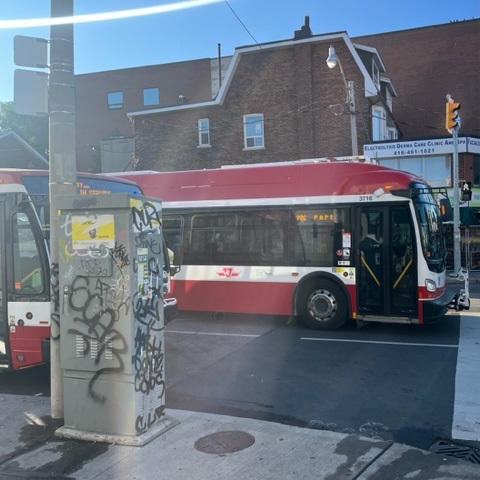
Avid readers of this blog will note there are many places in Ontario you can reach in a fairly inexpensive used EV. Turns out our city of Toronto is full of wonders, and thanks to a growing fleet of zero or low emissions busses (source), no need to burn fossil fuels to get to where you need to go. I recently rode one of their electric busses for a very smooth ride up the hill near where I live.
My bus for the ride was the Xcelsior charge NG from New Flyer (source). With a 440 kWh battery, which the manufacturer claims is good for 350 km. That’s about 0.8 km/kWh, which is not bad, given that the bus seats about 70, about 12x what my Leaf seats. Thus my 5 seat Leaf which gets 5 km/kWh works out to be about 25 passenger-km/kWh, compared to 56 passenger-km/kWh for the Xcelsior.
As always with EVs big or small, charging is the problem to solve. Most of the Toronto Transit Commission (TTC) busses sit idle during the night anyways, just like my Leaf, the sensible approach seems to be overnight charging (source, and source). This seems to give the buses enough charging to handle the morning rush hour, with a short charging break during lunch and its good to go for the afternoon rush hour. Again, since more busses are required to handle rush our vs regular daytime service, the bus is sitting at the depot anyways, why not charge.
Interestingly, the TTC has required the ability to charge via an overhead lines (source). This might be just for safety and convenience. After all, after a long shift, the bus operator just parks the bus, hits a button and voila the bus is charging without having to fumble with thick cables etc. But this Curiously enough, this might allow for clever charging strategies. Why not put one of these overhead stations in at say the end of the line. Its not unusual for a bus to sit idle at its end-stops for 10-15 minutes, as that helps keep the whole system on time. Thats time that could be used for charging, given some minimal investments.
We could go further, the copper mountain mine in British Columbia (BC) (source), has overhead wires for the uphill segment of the electric mining truck route. This provides ample charging for the truck, allowing it to keep going 24/7. We can certainly conceive of something similar for the TTC. In fact, the TTC already operates a network of streetcar routes serving downtown Toronto, why not charge of those? One could strategically expand the overhead cabling network where it makes sense to do so. That could give the electric bus just enough boost to make it through the day without a mid-day re-charge.
 Electric car adventures