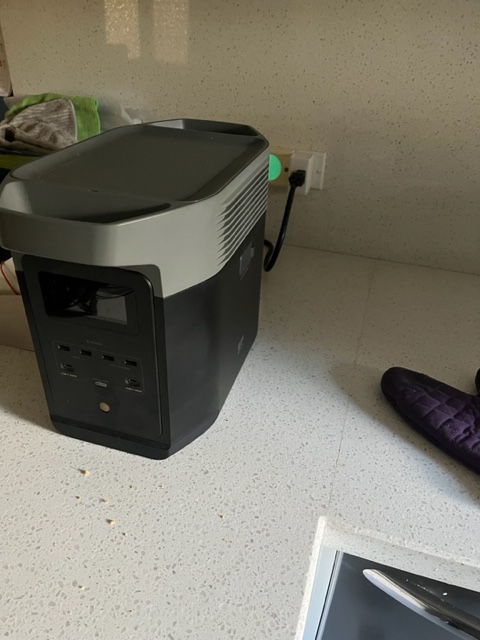
Previously we discussed a simple “peak-shifting” setup, consisting of a small eco-flow delta 2 battery in the Kitchen on a smart outlet which ensures the Eco-Flow charges up at the cheap and green ultra-low overnight rate, discharging to make air-fried treats and hot chocolate during the day. This has been a fairly successful setup, in fact I just leave my air-fryier and kettle plugged into the Eco-Flow and most days I use up the full 1 kWh of storage available to me, which begs the question, can I get more?
The concept is to shift electricity usage towards the cheaper off-peak hours. As it happens, that’s also when Ontario’s grid is generally much greener. A battery system, with some logic around the charging is how peak shifting generally happens. In my case, this is an Eco Flow 2, plugged into a smart outlet, which turns on during the cheap and green overnight hours. There certainly are more elaborate whole house batteries available (such as the Tesla powerwall, EP Cube and more) but this gives my Kitchen access to ultra-low overnight cheap and green electricity with minimum monetary outlay. In fact, this has been so successful, that most days, my Echo Flo 2 is drained, with one of my kids wishing for an extra cup of hot chocolate before bed. So what to do.
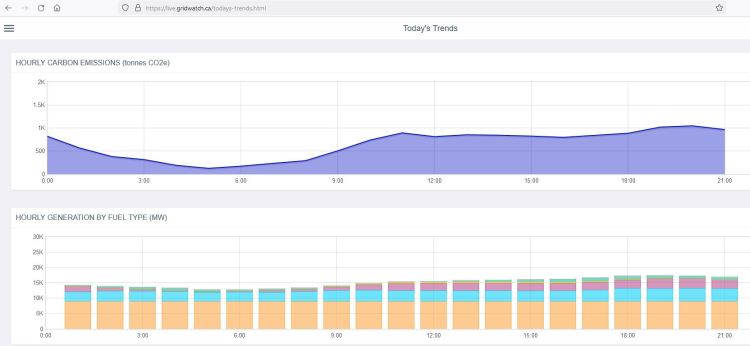
The simplest solution is just to adjust my smart outlet schedule to avoid 4-9 pm, but otherwise let the Eco-Flo top up, even if that is during the more-expensive afternoon/evening hours. But as can be seen in the screen-capture below from gridwatch.ca, it seems the gas peaker plants fire up around lunchtime, something that would be nice to avoid.
One option, is to add a solar-panel to my battery setup. Eco-flow has a range of panels which generally are fold-able and could be brought along on a trip too (source). With 5-6 hours between lunch and dinner, there is ample time to charge up the Echo-Flo Delta 2, even from a small-ish 200W panel, a 400 W panel might give better odds of filling it with solar during the day. If I managed to score 300 W, for 4 hours, thats 1.2 kWh for my Kitchen battery during the day in a very cheap/green way. But to fully take advantage of this, I would have to add some wiring to the outside, ideally on the roof, this is not easy.
Alternatively, one could add an expansion battery, here Eco-Flo offers a 1 kWh or even a 2 kWh extension battery. That certainly should keep the kettle boiling, and minimum wiring would be needed, as the expansion battery plugs into the main unit, and that’s about that.
With my situation, e.g. a “peak-shifting” battery in my Kitchen, I’m tempted to go for the expansion battery, mostly as adding the wiring for the solar panel is not easy, even if the solar solution might actually allow for more energy usage at a lower cost. Its an interesting example, on how solar can nicely compliment your battery system in a very green way.
 Electric car adventures