Tesla has to much fanfare introduced per kWh billing at least for some of their supercharger locations. Some third party charging networks are following suit, we discuss if that is a good thing? From the perspective of the user, it makes the charging more predictable, as there are occasions where either the station or the car elect to charge at less than ideal speeds. The operator however is burdened with fixed costs, and there is the issue of “hogging the charging station” with an EV that is nearly full and as such charging at a snails pace. Thus as with many things in life, its complicated.
Lets start with the issue of charging speed. If the charging speed is constant, well then it matters not if you charge for time or per kWh of energy used. The two are roughly equivalent. But alas EVs charging physics is more complex.
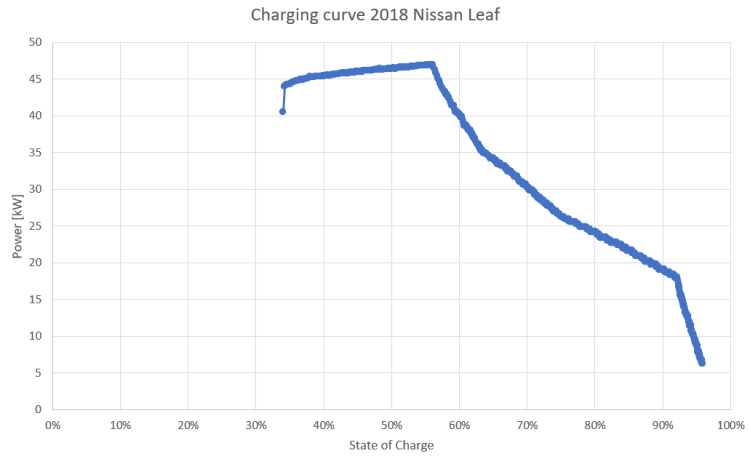
EV charging speeds vary a lot during the charging session. Generally most EVs charge at full speed only briefly, as the state of charge is low, at some point, it maxes out, then starts to ramp down as the battery fills. Consider the charging curve from a recent session recorded with LeafSpy on my 2018 Nissan Leaf. As you can see, we approach the max charging speed, only briefly at about 55% state of charge, after that, speed falls as the battery fills up, and we get a paltry 5kW (about 10% of the rated 50 kW DC fast charging speed), around the time I unplugged at 95%. These charging curves vary from EV to EV, and much depends on the state of charge, ambient and battery temperatures, cooling/heating available to the battery and so forth.
So from an economic standpoint does per kWh billing make sense for me? Generally, you will get a better deal if you charge slower, at least compared to a fixed hourly usage rate. Lets review some of my past charging receipts to add some real life data into our discussion. The table below shows some of my recent charging sessions using the three charging networks that operate near Toronto, ON that my 2018 Leaf can work with: Flo, Ivy and Petro Canada’s electric highway. I also included a L2 session as I saw an opportunity to graze electrons during lunch.

As we can see, cost per kWh ranges from $0.47/kWh to $1.33/kWh. Interestingly the newly announced Ivy per kWh pilot project (source), sets a price of $ 0.62/kWh, a bit higher than the two Ivy sessions listed in the table above. Although my 2018 Leaf cannot use supercharger stations, Tesla apparently charges somewhere around $0.3 and $0.5 per kWh, on the cheaper end of the range seen above (source).
So, is Ivy getting a little greedy here? Perhaps a little, but looking at the table above, Ivy has the cheapest per kWh rate, and the lowest per hr pricing. So Id say they certainly could charge a little more, for their charging services.
There is also the issue of idling EVs. If billing is by the kWh, then charging an EV when its nearly full, does not hurt nearly as much as it would when charging by the hour. Even better, leaving a fully charged EV plugged in, costs the owner nothing. Tesla has responded to this with idle fees, charging the EV a steep per hr charge if the car is not charging, although there has been some backlash (source).
 Electric car adventures