Recently we discussed hot water heater economics (see this post). With a heat-pump tank heater now installed, and some early usage statistics, we can now add real-world usage data to the mix and see how close we came in our earlier analysis. We find that our usage is higher than expected, but through some clever scheduling, we mostly achieve the ultra-low overnight energy price, hence the operating expenses are less than our old natural gas water heater.
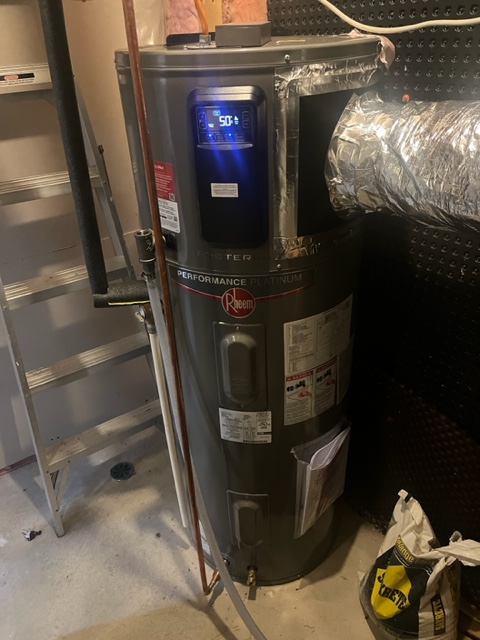
The water heater is now installed in our home. And producing plenty of hot water for our family, which now includes two teenagers, and we all do like our long nice hot showers. Installation costs were a bit higher than I expected, as we needed to use both an electrician to run a new 240V line from the breaker board to the utility room, and a plumber to do the plumbing for the new tank.
| Item | Cost [Canadian dollars] |
| Home depot, Rheem Proterra 50 G | 3,394.52 |
| Electrical work | 768.40 |
| Pluming work | 691.56 |
| Ducting parts, other misc items | 300 |
| Anticipated greener homes grant | -1000 |
| Total | 4153.48 |
This compares to a quoted $2683.75 for a high efficiency gas hot water heater, including installation. Thus the heat-pump hot water heater right out of the gate is $1469.73 more expensive. But what about operating expenses? The app that comes with the hot water tank, gives some usage information, as shown below.
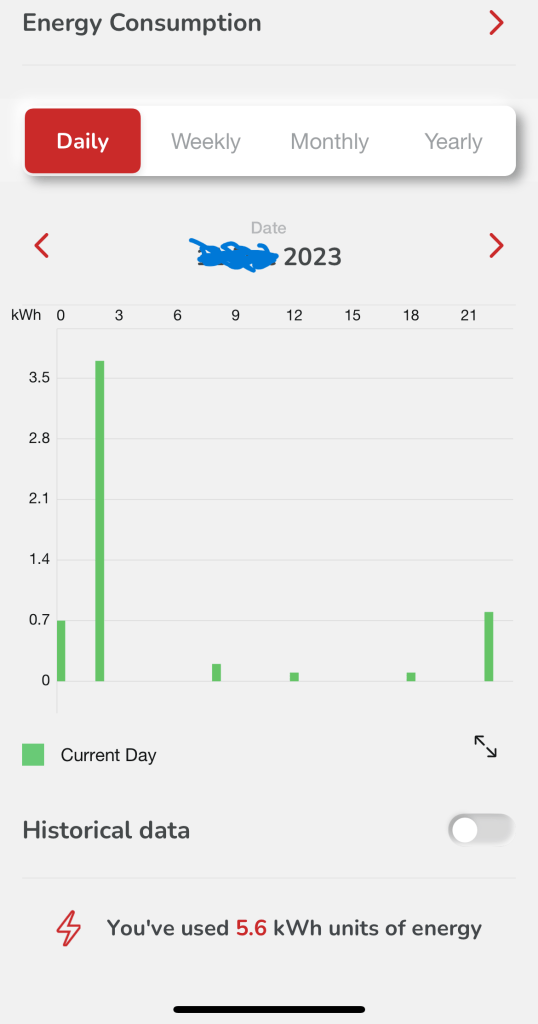
On this day, we used 5.6 kWh of electricity for the hot water tank. Of note, looking at the usage across the day, we find that only 0.6 kWh were outside the ultra-low overnight (ULO) hours of 11 pm to 7 am. Much of this was in the morning between 7 am and noon. Looking at past dates, this usage pattern of 90% ULO hours holds steady, with the daily total ranging from 4 kWh to 12 kWh, depending on household hot water usage. Part of this is owning to some clever scheduling, shown in the table below:
| Time | Mode | Heat setting |
| 7 am – 4 pm | Heat-pump only | 50 C |
| 4 pm – 9 pm | Heat-pump only | 45 C |
| 9 pm – 11 pm | Hybrid mode (Energy saver) | 50 C |
| 11 pm – 7 am | Hybrid mode (Energy saver) | 60 C |
Having the highest heat setting during the lowest energy cost allows us to use the water heater as a “heat-battery” as further discussed in this post.
But how would this compare to gas on an operating cost basis. Well, we need to assume an efficiency factor to convert from electric kWh to gas kWh. We operate the water tank mostly in hybrid mode, but the Energy saver mode does allow the elements to be used during high demand, so lets say 150% for our efficiency. A gas heater has about 60% efficiency, so our typical daily usage of 8 kWh electric, correspond to 20 “gas-kWh”. Recall that the heat-pump water heater is over twice as efficient as the gas heater. But on a per kWh price, gas is cheaper (source), gas costs 1.6 c/kWh compared to say 3 c/kWh (as were 90% on the 2.6 c/kWh ULO rate). For the 20 “gas-kWh” we thus pay 32 c/day, while our heat-pump water-heater costs 24 c/day. Why that’s a 8 c/day operating cost advantage for our hybrid electric water heater.
With a cost advantage of 8 c/day, but an installation being $1469.73 more expensive, it would take about 50 years of operations to overcome this difference. Hence, by the time it comes to replace the hot water tank (in 15 years time), cost wise, we still have 35 years of operating costs to catch up to.
This needs to change. From a safety standpoint, is a hot water heater any different than a washer/dryer? Both appliances have water and power running in and out of them, but I can install the washer and dryer myself provided the necessary hookups are in place, had I been able to do so, removing line-items for the plumber and electrician from the cost table above puts the installation cost on par with the gas heater (assuming the 1000 greener homes grant stays in place). Further, when time comes to replace the current heat-pump water heater, all the required electrical hookups are in place.
 Electric car adventures
One thought on “Does a heat-pump water heater save you money?”