As we have discussed, electric vehicles (EVs) are more expensive to purchase, but cost less to run. How does all of that shake out in terms of a total cost of ownership (TCO)? Much discussion has emerged on TCO of electric cars, some have gone as far as suggest the Tesla model 3 has a lower TCO than the Toyota Camry (source). I like to define total cost of ownership as every dime you spend on your car over a certain period of time. With that, lets go back in time and see if getting any of our EVs in my last used EV survey 5 years ago was a steal from a TCO perspective. While its true that EVs are much cheaper to operate, depreciation, the difference between what you bought the car for and what you sold the car at, is a big component of total cost of ownership. Often to such an extent that it dominates TCO math, thus if interest rates are low, gas is expensive, and your EV grows in value, that Toyota Camry might be a lot more money than an EV.
A word of methodology: Lets add up the costs using the following assumptions: We bought an EV for the listed manufacturer suggested retail price (MSRP), then managed to get what we listed as mid-price in the most recent used EV survey, drove the Canadian average 15 000 km/year, achieved 80% of the quoted EPA efficiency and paid 15c/kWh for electricity. We do some googling for maintenance, and insurance costs, adding in my experience with my two leafs now.
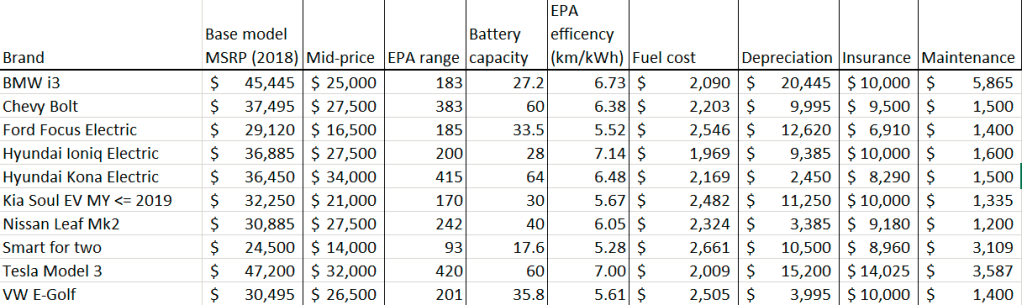
We omit models that were not available new back in 2018. I did have a hard time obtaining sensible figures for insurance and maintenance. In particular for the BMW i3 and Smart for two. Granted, there will always be some range of values that make sense for insurance and maintenance. Some are willing to use an app that grades your driving style in return for cheaper premiums, or are willing to accept lower liability coverage. Further, as I am a ski-bum, I really want winter tires. If you live in warmer climates, or have no interest in driving in any snow, your maintenance costs will be different. I did aim to ensure maintenance included one set of tires over the 5 years, plus an annual “low-hundreds-of-dollars” shop visit, but alas there will always be fauna on that front. Tesla Model 3 lost brownie points as buddies of mine that have it, report higher insurance and winter tire costs perhaps as its a more “sporty” brand? As discussed, these values should be considered approximate at best, but taking the average over all brands, we can see how our four cost categories (Electricity, Depreciation, Insurance and Maintenance) compare.
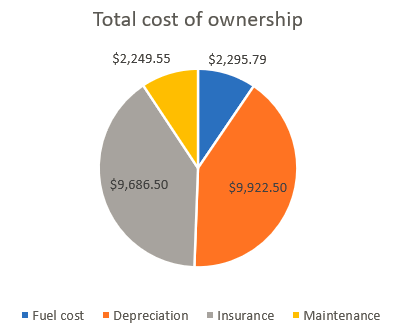
Interestingly, depreciation, which we define as the base MSRP – average used sell price in 2023, is the largest cost component. Second we have insurance, followed by fuel (eh electricity actually) and maintenance. Of note, fuel and maintenance are much smaller cost components than insurance and depreciation.
In fact, it could be argued that depreciation is likely much higher than listed. After all, one could place the $35,073 it took to obtain the average base model at MSRP back in 2018, and get some interest on it. Depending on the assumed interest rate, our Depreciation grows from $9,923 to almost $20,000, dwarfing other cost factors of total cost of ownership. Thus if interest rates are low, and gas is expensive, that cost premium on EVs is less of a problem, and the lower cost of electricity compared to gas, more of a benefit. These conditions might nudge even the most expensive EV in our table (the Tesla Model 3) ahead of the Toyota Camry.

 Electric car adventures
One thought on “Total cost of ownership?”