Having had our heat-pump for a couple of months now, we have some experience configuring it. Briefly, the heat-pump will produce heat down to -27 C, but performance is progressively reduced once it gets colder. Thus, depending on your home insulation, climate control settings etc. you need to choose what Daikin (our heat-pump brand) calls the Balance point, namely at what exterior temperature should you switch over to gas heating? We discuss several factors, from economics, to weather data, to system capabilities. We settled on -10C as a sensible balance point, when it gets colder than that, the gas furnace takes over.
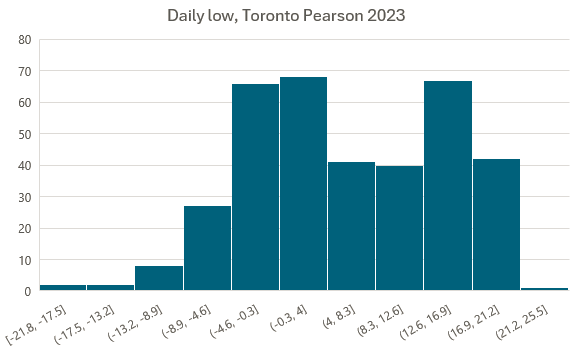
Lets start with the weather. How often does it get really cold in Toronto, ON? The Canadian government offers you the opportunity to peruse historical weather data (source), it seems as 2017 came to a close, the temperature bottomed out at -22 C. Looking at last year, 2023, the daily low got almost to -22 C, but interestingly enough, only 12 nights were cooler than -8.9 C, with about 39 nights cooler than -4.6 C. Hence if we choose a balance point cooler than -8.9 C, our heat-pump will operate at least 96.7% of the time. And if we opt for -4.6C, our heat-pump operates 89% of the time. Thus picking something cooler than -5C keeps the heat-pump firmly in charge of our house heating.
Next, lets take a closer look at the spec sheet for our heat-pump. For a variety of reasons, the amount of heat a heat-pump can produce reduces as it gets cooler (source). Shown below is a graph outlining the amount of heat generated during performance testing. We get this briefly by multiplying the electrical energy in, with the coefficient of performance. We should point out, this testing generally used 2-3 kW of electricity going in, presumably as that produced the most acceptable coefficient of performance. Our Daikin for example has a “boost-mode” where the amount of input power is doubled, hence we might manage to get more heat out of it than these data indicate, but the trend (e.g. less heat as it gets colder), will hold true in general.
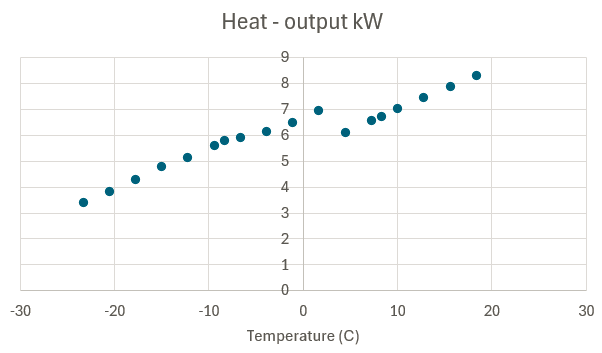
So, how much heat does it take to warm the house? Well, that depends generally on the outside temperature, and your insulation. Generally, as it gets colder, you will need more heat, however the physics of the heat-pump go the other way. This is the main reason why you may need a supplemental heating system. Much also depends on your climate preferences, the cooler you prefer your home, the less energy it will take to warm it. We generally prefer 19 C during the day, and 17 C at night, and we found when it got cooler than -10C outside, our heat-pump had a hard time heating our house from 17C to 19C in the morning. This was the main reason we picked -10C as our “balance point”.
But, we ought to discuss economics as well, here the coefficient of performance (COP, defined as the heat-pump heat output vs the amount of electricity going in) becomes important. Recall our discussion on Heat-pump economics, electricity prices are approximately 2.7 c/kWh to 25 c/kWh depending on the time of day, while natural gas prices are 1.6 c/kWh. Lets look at four particular power prices in more detail: 2.7 c/kWh, 8.7 c/kWh, 12.2 c/kWh and 28.6 c/kWh (source). These correspond to the ultra-low overnight rate, weekend rate, the mid-peak rate (daytime on weekdays mostly), and peak rates. We take that, along with our COP data from above, and compare to the 1.6 c/kWh for gas, assuming 90% efficiency for gas heating.
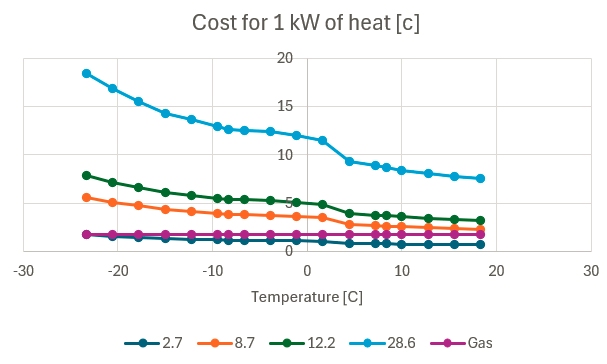
As expected, the heat-pump gets more economical the warmer it gets. This is owning to refrigerant physics, but generally, as the heat-pump gets more efficient with warmer exterior temperatures, our heating bill goes down. Interestingly, even at frigid exterior temperatures, the ULO (2.7 c/kWh) rate still is more economical than gas. Also, the slightly higher weekend rate (8.7 c/kWh) never really catches up with Gas, although it does get close. In practice, we get a mixture of all of the above energy rates, depending on when the heat-pump kicks in, thus, from an economics standpoint, its best to design your schedule around your energy rate. We certainly have, using the following schedule to minimize usage during the high peak rate.
| Time | Temperature setting |
| 5 am to 4 pm | 19 C |
| 4 pm to 9 pm | 18 C |
| 9 pm to 5 am | 17 C |
 Electric car adventures
2 thoughts on “Balancing your heat-pump and gas”