Price of electricity varies greatly depending on the time of day. Here in Ontario, 1 kWh will cost you 3c at night, but 30c during peak hours. This is where a home battery might comes in handy, why not charge up during the the night on cheap-electrons, and discharge during expensive hours? Lets explore the economics of this idea. We note the opportunity to save about $80 per month on the electricity bill. With a likely project budget of about $15-25k, this yields a payback period of 15-25 years.
Lets look at my last power-bill to see how much energy I am using, also listed are my ultra-low overnight rates (source).
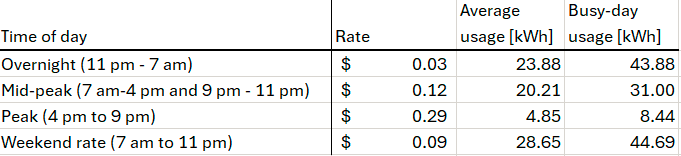
I did some statistics, to arrive at what I call “busy-day usage”, which is just about two standard deviations above the average usage, but it does give you some idea of how my energy usage fluctuates. The simplest business case for a home battery system, is to charge it during the night at the cheaper rate, then discharge to replace my usage at the higher. This could lower my energy bills by about $81/month or $1k/year.
Exporting electricity to the grid is sometimes an option, much depends on where you live, and how open your electricity provider is. Here in Toronto, I hear Toronto hydro is fairly open to this, and legislative policies are generally “net-metering” friendly. Although it seems they were mostly conceived to permit rooftop solar (source, and source). This could improve the economics of the project.
Of note, most of the home battery systems on the market are around 10 kWh in terms of capacity (source), from the table above, this would cover my peak usage, although not the mid-peak usage in the mid-peak and weekend periods. Hence a supplemental solar system or a second battery might make sense as that way I could offset more of my mid-peak usage.
In terms of costs, $15k seems an optimistic number (source), but might provide say one Powerwall with about 13.5 kWh of storage (or a similar unit), which is not quite enough to cover my average day. Adding on solar, or a second Powerwall would possibly increase the project budget to $20-25k.
 Electric car adventures