We have discussed several solar and or battery projects in previous posts. Usually the economics are rather abysmal with payback periods stretching into the decades. At the heart of this is the relatively low per-kWh electricity price, of only 10 c/kWh “ish” (source). Compared to say Californians who must fork over 33 c/kWh (source). But we pay a comparatively high “connection fee” of $40 /month, compared to $10 for Californians. Lets explore an alternate billing structure, whereby we lower the “connection-fee” and increase the per kWh price. What does that do to payback periods for rooftop solar?
Lets peer into the Ontario’s energy boards report on what they considder the “average-customer” (source). We learn that the average customer pays approximately $130 per month, for 750 kWh of usage. From Toronto Hydro, we learn that the fixed portion of the bill (which they call “customer charge”, is about $45 source). Thus, on the average, this corresponds to a $130-$45/750 kWh = 11 c/kWh price for power. Lets see what happens to the “power-price” as we lower the “customer charge”.

As you can see, in order to keep the average bill at $130, if the “customer-charge” were only $5, we would need to increase the price per kWh to 17 c/kWh. There is the crux of the argument, at 17 c/kWh, solar economics are a lot more appealing than at 11 c/kWh. We need to do some math, in order to obtain a similar figure for a say, solar system. Using figures from Solar Ontario’s 2023 report (source), we arrive at 10 c/kWh for solar.

If true, solar is cheaper for all the “customer-charges” we looked at in the table above, but we got that initial $15k to make up, with our per kWh savings. Again, to keep things simple, we stick to the same assumptions, on energy usage and billing as we had before.
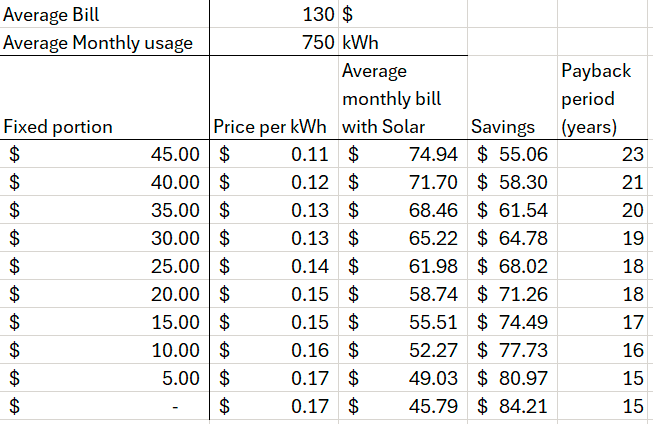
We now have quite a few additional columns in the table. As you can see, the higher per kWh billing rate, when we drop the fixed portion of the bill, really helps the return on investment. We go from 23 years to 15 years for our payback period.
From a public policy perspective, this change, of lowering the fixed portion of the bill, but increasing the price per kWh to compensate, will undoubtedly have similar effects on a whole range of energy efficiency investments. Walking the dog through my neighbourhood I am surprised to see how many 80’s style air-conditioners are still around. These old AC units might use 5-6 times the energy of my modern heat-pump unit (source), and they wont heat your home in the winter-time.
 Electric car adventures