Ever since London (UK), started enforcing a congestion charge back in 2003, some have suggested that Toronto should do the same. London’s scheme evolved over the years, and starting in 2025, any car entering central London (congestion zone), will need to pay a fixed fee. There is a pair of larger zones (ultra-low and low) emissions zones, where green vehicles are permitted without paying a fee. Proponents point to studies showing 12% reduction in air pollution (source). But the politics are tricky, while many in downtown Toronto might support this, many in suburban areas, where the car is king, might oppose. This makes it tough, as provincial and federal elections are won and lost in the suburbs.
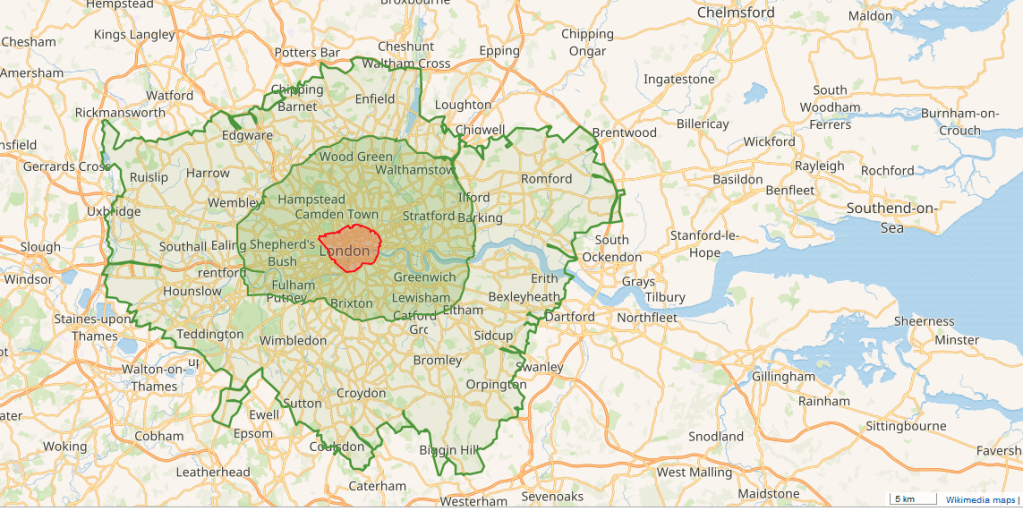
The image below shows the boundaries of London’s three emissions zones at the time of this writing (June 2024). Enforcement is through an extensive camera network, where license plates are recorded and compared to a database of who has paid and for when.
Proponents have largely pointed to reductions of pollutants over the 20 year history of the program, shown below for nitrous oxides in greather london. As you can see, the proportion coming from transport for London’s (TFL) buses has reduced dramatically, while that from private Diesel cars has stayed, suggesting that a low emissions charge might tip the scales to improve air polution.
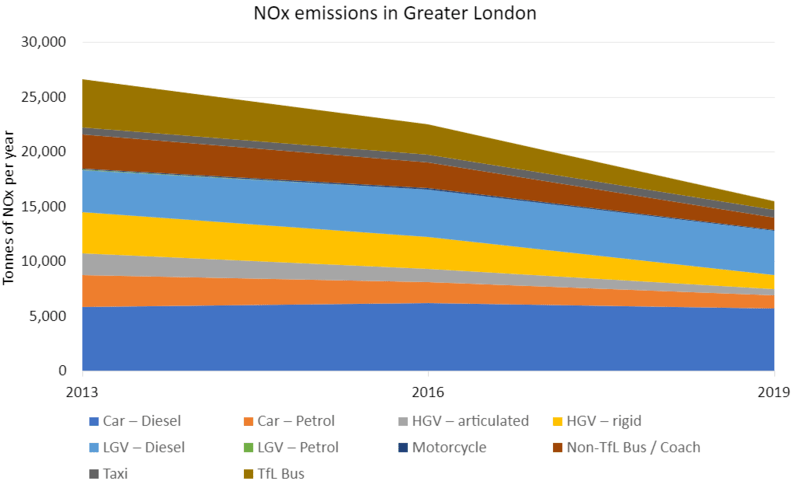
Interestingly enough, Toronto East air quality monitor measures a similarly declining NO2 (major component of NOx) concentration (albeit in averaged units as opposed to Tonnes/yr used above).

Thus this does suggest that perhaps London might have achieved similar results without an emissions charge. Nevertheless the ULEz has undoubtedly provided a nudge towards more Londoners buying EVs. Which suggests the same might be true in Toronto, and this could be a powerful incentive should say, the Carbon tax be “axed” as the opposition leader is fond of saying these days.
 Electric car adventures
