I recently had a chance to spend some time with an old beast, the Subaru Legacy that is at least 15 years of age, but possibly closer to 35 (there is some ambiguity on the registration documents). With affordability high on peoples mind these days, for you my dear reader, I took the plunge and borrowed a relatives old geezer for a two week trip. Overall “Dart” has very low fixed costs, while fuel burn and a coolant leak result in higher operating costs per driven km compared to a new Tesla Model 3. A similar argument could be make for emissions, thus if your driving is rare and mostly highway based, Dart might be a contender.
It is a common debate among environmentalists: Should you keep you old car going, or splurge for a new EV (source)? Much depends on how much you use your car, while that new EV on a per km basis, is much better for the planet than the old gas guzzler, those fancy materials used nowadays result in a significant environmental “initial-cost”. Hence if you drive a lot, then by all means get that new EV, but if you only occasionally use a car, perhaps its better to wait?
A key figure is fuel economy. Our time with “Dart” we got about 8 l/100 km in mixed driving, which for “Dart”‘s size and age, was not bad. Further, we discovered a coolant leak of about 100 ml/100 km, not bad. This results in emissions of about 18.4 kG CO2/100 km. Hence for a typical Canadian driving 15 000 km per year, that’s about 2.8 t CO2/year. Or about 3-4 years assuming a new EV generates 8.8 tonnes of CO2 during its production (source).

Looking at the economics. I slipped my relative a couple of whisky bottles for my two weeks with Dart, which I got from the duty free for perhaps $100. In addition I had to purchase a coolant bottle for $50, and after driving about 500 km or so, found myself spending about $200 for gas. Thus my per km cost of “Dart” was about 70c/km. Of that, its really only the Whisky that counts as “fixed” costs, hence a car like “Dart”, has as we will see, comparatively high per km running costs, while fairly low fixed costs.
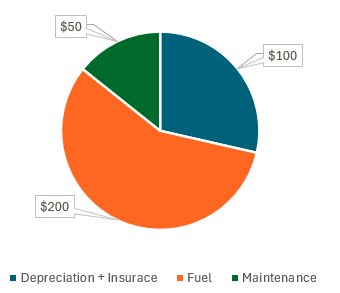
Peering into Edmunds total cost of ownership for a 2022 Tesla Model 3 we see a very different story (https://www.edmunds.com/tesla/model-3/2022/cost-to-own/). For example, fuel costs are only 5% of the estimated total cost of ownership, compared to 57% for Dart. Similarly maintenance is about 10% for the Tesla, while 15% for “Dart”. “Fixed costs” on the other hand dominate the Tesla’s costs, with 80% spent on Insurance, Financing, Depreciation and Taxes, compared to 30% for Dart.
And therein lies the economic advantage for Dart, if you drive little, Dart again comes out ahead. But if you do the average 15 000 km/year, then according to the above Edmunds article, the Tesla Model 3 costs you about 60 c/km, actually a little less than the 70 c/km for Dart.
I should point out that with newer cars such as the Tesla Model 3, getting a solid handle on depreciation is very challenging. Lately Tesla’s price-cuts have resulted in dramatic used price reductions (source). Thus depending on when you bought the Tesla, youre either very happy (got a new one at a steep discount), or very unhappy over the unexpectedly steep depreciation. Given the heavy weighting of fixed costs in the Tesla’s economics, your actual per km cost may vary quite a bit, and Dart might eek out a win there, in particular if you do not drive much.
Environmentally, a similar story unfolds. For the Tesla, it will take some amount of driving to counter its higher “production emissions” compared to a gas car, particularly if that gas car is say Dart, manufactured long ago, and hence more or less “written off” manufacturing emissions wise (source).
Another tidbit was range anxiety. Dart was a solid 400 km car, “range” we guessed was somewhere between 400 and 600 km. Since Dart runs on dino-juice, and our travels took us to rural areas where gas stations were hundreds of km apart, this caused some concern since unlike my own 2018 Nissan Leaf, I can’t just plug it in at the farm.
Of course, if you really want green, why not consider a used EV, as we discussed in the spring, there are quite a few of them now looking for a new home (https://electriccaradventures.ca/2024/05/20/used-ev-survey-spring-2024/), get the best of both worlds, a “written off” old car, and no tailpipe emissions.
 Electric car adventures
One thought on “Driving “Dart Wader” a 2007 Subaru Legacy”