As many jurisdictions edge closer to a ban on internal combustion engine car sales, panic is rising in some quarters, some even go as far as to suggest that EVs are much much inferior to gas cars. As discussed in a previous post, the situation is more complicated. For short journeys such as your commute or a short errand, the EV is much better. On a cold winter day, the EV brings you instant cabin heat, while you get to wait 20 minutes “for the engine to warm up” before you get warm. If you can charge at home, its hard to beat in terms of convenience. There is the inter-provincial road trip, where the gas car might have an advantage, however even there, owning to our bodies needs for breaks, the EV is catching on. Lets see how this breaks down, in terms of several brands from our recent Used EV survey.
We look at the table from our used car survey, where we look at mostly EPA testing and wikipedia to obtain idealistic values for charging speed, and battery capacity. This lets us add to our modelling and we add some columns. The first is number of charging stops. Here we look at the 8 hr duty day distance, then divide by 80% of the EPA range, emulating an 80% charge level on a road trip. Next we take our efficiency number and multiply by the charge speed to obtain the km/hr charging speed.
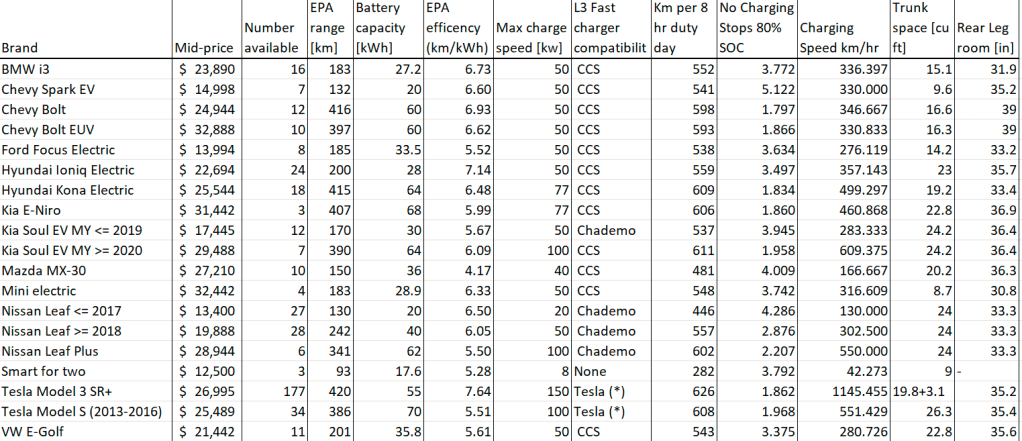
Looking at the pack, with the exception of the “Smart for two”, just about all of the EVs on our list make 500 km in a day, with some going past the 600 km post. To do this, charging en-route is required, with the higher end models requiring perhaps 3 stops, but Id plan for at least 2.
That said, I recently chatted with a friend who routinely drives from Toronto to Nova Scotia. This they do with 7-10 stops over two days. How would our EVs do on the Nova Scotia run? Lets add a few Nova-Scotia specific parameters to the table, google maps tells us its about 1800 km to Halifax Nova Scotia, from Toronto following the “Canadian-route”, which my friend does more or less. Google maps estimates 18 hours of driving, adding say 4 hours of stops to that figure, to model my friends rest stops, we arrive at about 22 hours.
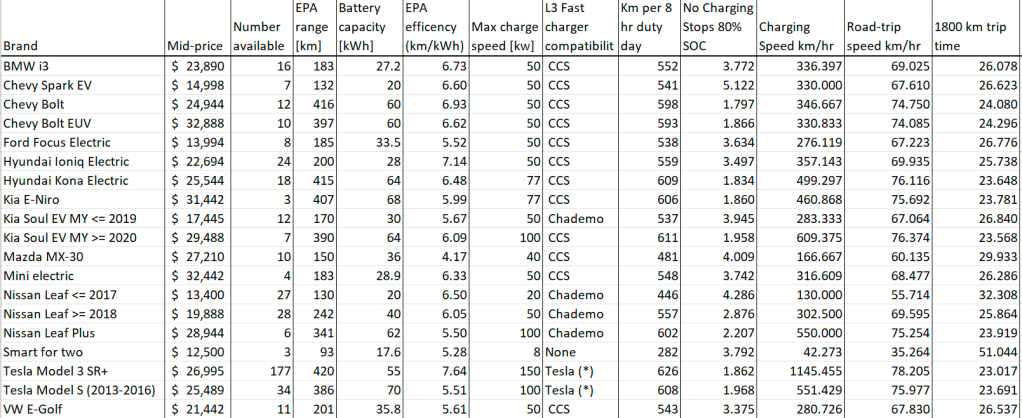
From the table, we see that the Tesla model 3 SR+, comes closest to that at 23 hours, while quite a few manage within a few hours of that figure. I did check a few models against https://abetterrouteplanner.com/, the Tesla Model 3 was predicted to get there in 22 hours, The Nissan Leaf 2018 in 26 hours, and the Hyundai Kona in 23 hours. All-told, fairly similar numbers, although it seems my figures are a little more pessimistic than a better route planner.
That said, these figures, on all sides are idealistic. My Friend for example, does not drive 22 hours straight, instead they stay over in Quebec at a family friendly hotel that has a water park, breaking up the drive into much more manageable chunks. An EV owner might similarly choose a hotel with overnight charging, and be strategic about where to take rest stops to take advantage of fast charging stations while enjoying some local delicacies.
Further, traffic delays, charging station problems, fueling problems and so on, add to delays on any road trip, be it with a gas car or an electric one. Also suitable refuelling (or charging) infrastructure may not be exactly where you need them, which might cost some time. There is also nuance in the charging curve, with most EVs only hitting max charging speed for brief periods of time.
It is interesting here, that even for such long inter-provincial road trips, the EV is quite competitive, yes it is a little slower, but some of the faster charging/higher range EVs are quite close to the gas car, certainly within a tantrum or two if you are travelling with the family.
 Electric car adventures