One Marion King Hubbert (source) proposed something called “peak-oil” back in 1956. Briefly, when charted by year, oil production tends to follow a bell curve for a given geographical region. Let’s look at this sideways and review statistics on annual gasoline sales for a few regions: California, Norway, Texas and Ontario. Interestingly enough, in all cases, the mid to late 2000’s is the peak in all cases, assuming a 10 year lag between “new-sales-rules” and their effect in gasoline sales, we see that fuel efficiency has greatly reduced gasoline usage. This might result in fewer gas stations, and by extension provide a powerful incentive for drivers to go electric.
Government agencies keep excellent statistics on motor vehicle sales. While there are some differences in the reported units between the different agencies, we have done our best to convert everything to annual sales in litres. We hope the reader will forgive me and kindly report any errors in the comments. Of note, the “shape” of the curve, is independent of “scaling”, e.g. suppose I made an error and instead of litres used gallons, as it happens the numbers will change, but squint a little, and the “shape” of the curve will remain unchanged, which for our purposes, is the point. We obtained data from The US Energy administration (https://www.eia.gov), Stats can (https://www150.statcan.gc.ca), and statistia (https://www.statista.com/).
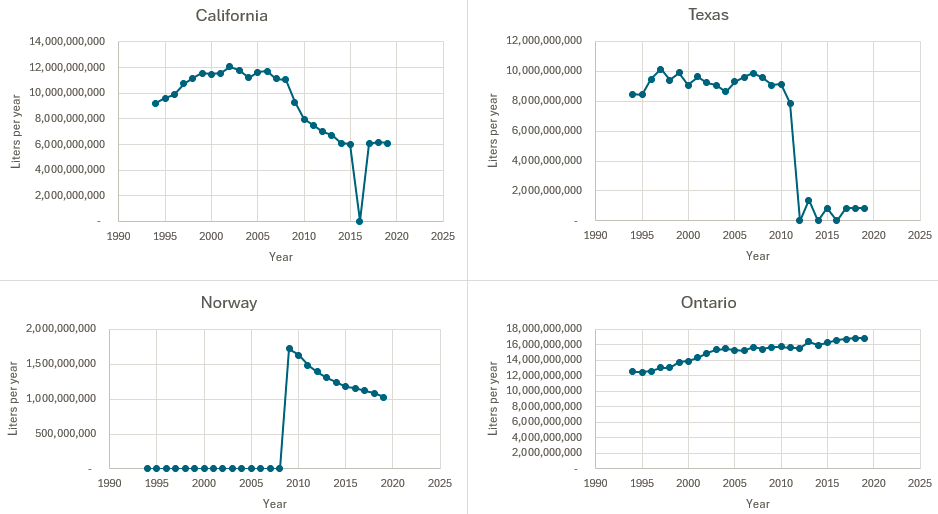
The overall picture is one of flattening or lowering gasoline sales. Our data ends before 2020, before EVs became more widely available. Some of this is to avoid talking about the pandemic and trying to tease out whats what during the turbulent pandemic years. In Ontario’s case, if you do look at the early 2020’s you do see a drop in “motor vehicle fuel sales”, thus in some ways, the story is the same no matter where you look, less and less gas is being used.
The trend towards bigger SUVs has in some ways largely played itself out (source), further fuel efficiency has improved greatly over the years, and we are now at a point where fuel efficiency improvements seem to be a stronger force than increasing SUV sales (source). More and more EVs and hybrids will also further reduce gasoline sales, and by that it seems less gas might translate into fewer gas stations providing a further incentive for drivers to go electric.
I should point out that there are some significant differences in how the numbers are obtained. For example, Ontario and Norway use gasoline tax data to compute the overall volume of gasoline sold, while California and Texas get their data from refiners. This could produce some important differences for example an incident in the mid-2000’s might explain a dip in the Texas figures (source). Also, gas refined in say Texas might be sold in California and vice versa, or some other state entirely (source). Nevertheless, the overall trend might prove instructive, namely that less and less gasoline is being sold.
 Electric car adventures