I recently travelled to Japan, while there, its hard not to admire the Shinkansen, the Japanese high speed rail network. Particularly while zooming along at 320km/hr with barely a ripple in your tea. But does such a service make any sense in Ontario? Some have pointed to Canada’s vast geography, others point to the cost, but the real reason might be demand, it might be hard to fill a 1200 seat train, particularly if one comes by every 3 minutes.
Lets start with cost and geography. Compared to Japan, Ontario is bigger, but considerably less mountainous. That turns out to be important, as digging tunnels is expensive, very expensive. In some ways, Ontario has the ideal landscape for high speed rail, with its fairly flat terrain, much of it farm-land. Recent studies suggested construction costs of about $55M per km (source), which is about 5 B, 2004 Japanese Yen per km. Comparing that with the table below puts the cost on parity with the Shinkansen.
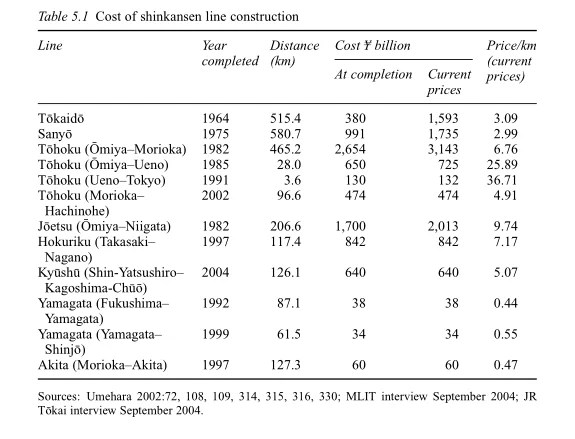
Discussions have so far centred on the Windsor-Quebec city corridor, which spans a distance of some 1200 km, of which 900 km are in Ontario. Compare this to say the Osaka-Tokyo Tohoku Shinkansen, 675 km, and the Tokyo-Hakodate Hokaido Shinkansen, 825 km (source), end to end, on these two lines, we find ourselves with a 1500 km journey.

Thus neither cost nor geography seem unreasonable in the case of high speed rail in Ontario.
Infrastructure is usually cost effective, only if its being used, ideally a lot. When I was in Tokyo waiting to board the 12:08 Tokaido Shinkansen, there were trains departing roughly every 3-5 minutes, from 6 am to midnight. Each of these had about 16 cars, each with 20 rows of 4 seats. That’s 1200 seats per train, 15 trains per hour, 18 hours a day, for a whopping 325 000 seats per day! No wonder the Tokaido Shinkansen carries a whopping 174 M passengers per year.
Is there a need for so many passengers in Ontario? Well, lets look at some competitive means of say Toronto-London, Toronto-Montreal. For Airlines, I assumed an average of 80 seats per flight for Windsor and London (mostly served by Air Canada Express or Porter Airlines Q400s), and 120 for Toronto-Montreal as larger aircraft are used for some of these departures. Then I went to Expedia choosing a random date in October (Wednesday October 9th 2024), and counting up the nonstop flights. For the 401, I used 2016 ridership statistics (source), and 1.5 riders per car (source). Via rail was similar to the airlines, in that I went to viarail.ca and counted up the non-stop trains. I assumed 4 cars per train, with 80 seats each.

As you can see, the annual ridership is nowhere near the 174 M for the Tokaido Shinkansen. Some of the less popular Shinkansen services do see similar ridership levels, such as the 15M passengers per year on the Kyushu Shinkansen which serves the island of Kyushu in south western Japan.
The distribution between the three modes of travel is interesting, looking at the totals for our four routes, the 401 is carrying 94% of the traffic between the four cities.

So, given all this would the Sinkansen work in Ontario? Not sure, its a large ticket item, which would cost some billions of dollars, and even now, the ridership on the four routes studied here is not quite up to Shinkansen levels, hence high fares might preclude the ridership numbers you need in order to make this work. Also, once you get to say Windsor or London,ON, is a car going to be useful? If so, the 401 is a tempting proposition.
 Electric car adventures