In some markets, particularly ones with lots of solar such as California, Electricity prices reach their lowest point not overnight, but in the middle of the day. The reason for this is the glut of Solar power that hits the grid at that time. Particularly in the spring, when its sunny, but not yet hot. Naturally, grid operators want to utilize as much as possible of the clean green energy that is solar, but sometimes, there is not enough demand on the grid to do so. This causes wholesale electricity prices to reach their cheapest in the mid-afternoon.
The California independent systems operator, is the agency responsible for managing California’s grid. Its operators started to notice that electricity demand fell unexpectedly in the middle of the day as rooftop solar offset the demand on the grid. As you can see below, (chart from https://www.energy.gov/eere/articles/confronting-duck-curve-how-address-over-generation-solar-energy), the demand on the California grid, on March 31st does indeed resemble a duck.
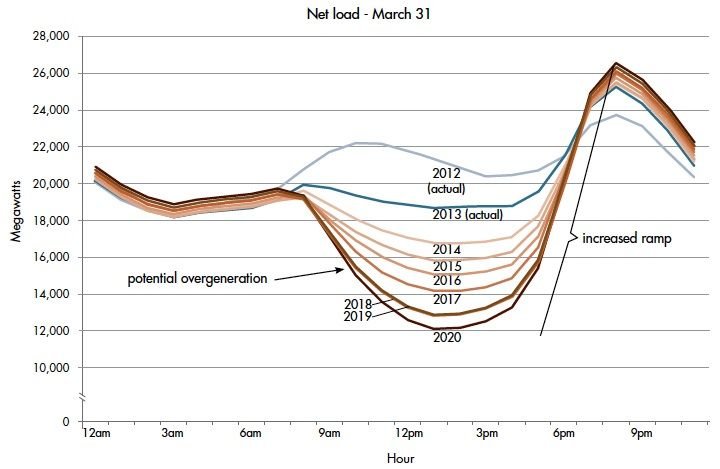
In markets where whole sale electricity prices are deregulated, such as California, this causes a drop in prices in the afternoon as solar floods the grid. In some places, even negative prices have been reported, where producers will pay you for using power.
This is why energy storage is such a compelling complement to renewables, as it mitigates the intermittency of renewables, if there is an unexpected glut in power, why not take advantage and charge at a discount. If there is a shortage, why not help the grid by discharging.
Indeed there are lots of applications that have some flexibility in when you use power. AI model training for example can take a break from time to time (source). Aluminum smelters can apparently somewhat modulate their energy use (source). I have some flexibility in when I charge my EV and so on and so forth. I recall from a high-school job at a machine shop, that they had an parts washer that needed very hot water to work, but they had a deal with the local power utility, which in return for substantially lower energy prices, and some guarantees on minimum usage, installed a remote off switch, which was triggered usually around dinner time when the utility had high peaks.
There is the simple answer to the duck curve. Provide some incentive for the user to adapt their electricity usage to the power supply. Why run AI models at night when it might be better to do so during the day?
 Electric car adventures
One thought on “The “Duck” curve”