As keen readers of this blog might have noticed, our 2018 Nissan Leaf works perfectly well for all our needs. But there is the Tremblant run (source). While it is doable, and we have done it many times. The 11 hour program is a wee long. So with that in mind, and of course for science and you my dear reader, I went of to Hertz to see if they had something electric that might get there quicker. Love and behold, they happened to have a Kia e-Niro I could check out for the weekend, so off I went. Compared to my Nissan leaf, the e-Niro has a larger battery pack, on par with the Nissan Leaf Plus. But its charging characteristics are much improved. The two combine to get to me to Tremblant in 8 hours and 15 minutes.
We begin with a re-cap, the route from Toronto to Mnt. Tremblant is about 550-600 km, depending on the route chosen. Breifly, all routes go through Ottawa, but there is some fauna as to how to get to Ottawa. There is Hwy 7 via Peterbourogh and Carleton Place, then there is the 401-416. The 401-416 is faster with better charging, but longer. Then we have some hybrid approaches, say take the 401 to Bellville, then switch to hw7, or take the 401 to Kingston, then go North through Smith’s Falls.
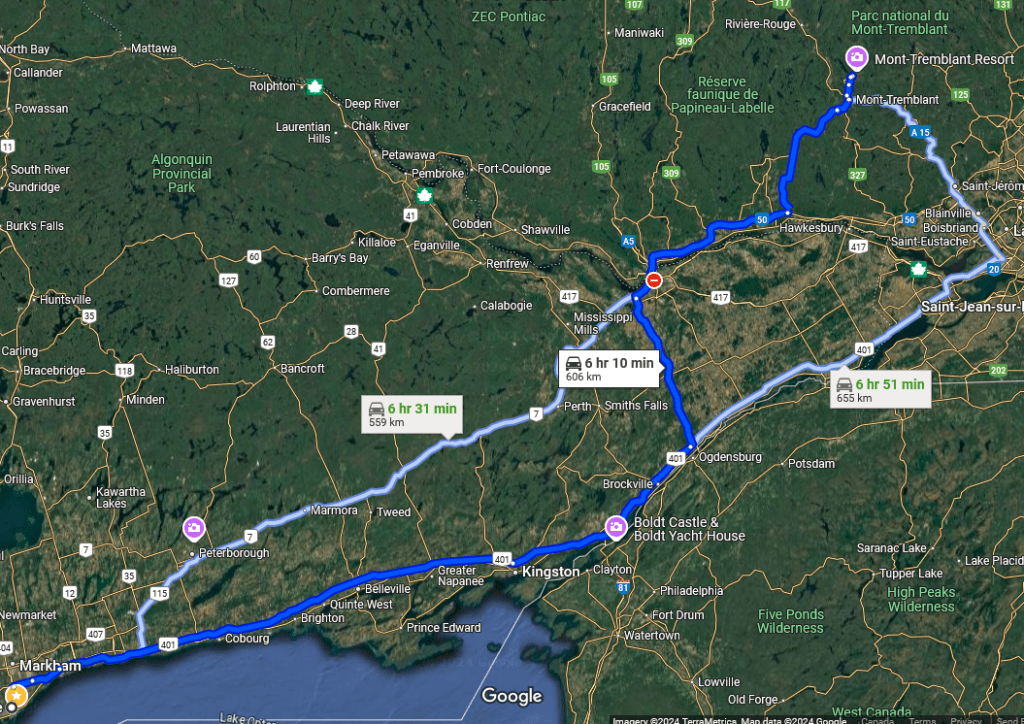
With the Leaf I usually take the 401 to Belleville, then switch to the slower Hw7 route for some “active-cooling” and wind up getting a decent second charge in Carleton Place. I have tried to use a portable fan for some additional cooling, but try as I might, the fastest my 2018 Nissan Leaf has made it to Tremblant, is 10 hrs and 33 minutes (source).

As the E-Niro has faster charging than the Leaf, we decided to take the 401-416 route as it is faster than the Hwy 7 option.
Enter the rented Kia E-Niro from Hertz. It turns out Hertz has quite the fleet of EVs, I counted 5 Polestar 2’s, 5 Tesla Model 3’s and 3 Tesla Model Y’s in the Hertz garage, in addition to the Kia E-Niro. My Kia E-Niro had a 64.5 kWh pack, supporting up to 90 kW of DC fast charging, which I saw for a brief moment, it seemed to prefer 60-70 kW. The charging curve got interesting around 80% state of charge. Very suddenly, as the state of charge gets to 80%, charging speed drops from about 45 kW at 78% to 20 kW at 79 %. Hence, at 80% SOC, that’s usually when we unplugged and motored on. Active battery conditioning ensures consistent charging performance, as I discovered on my third fast charge of the day (source). The car drove quite well, the traffic aware cruise control worked very well, the lane keep assist ping-ponged a bit too much for my liking, but kept the car firmly in the lane.
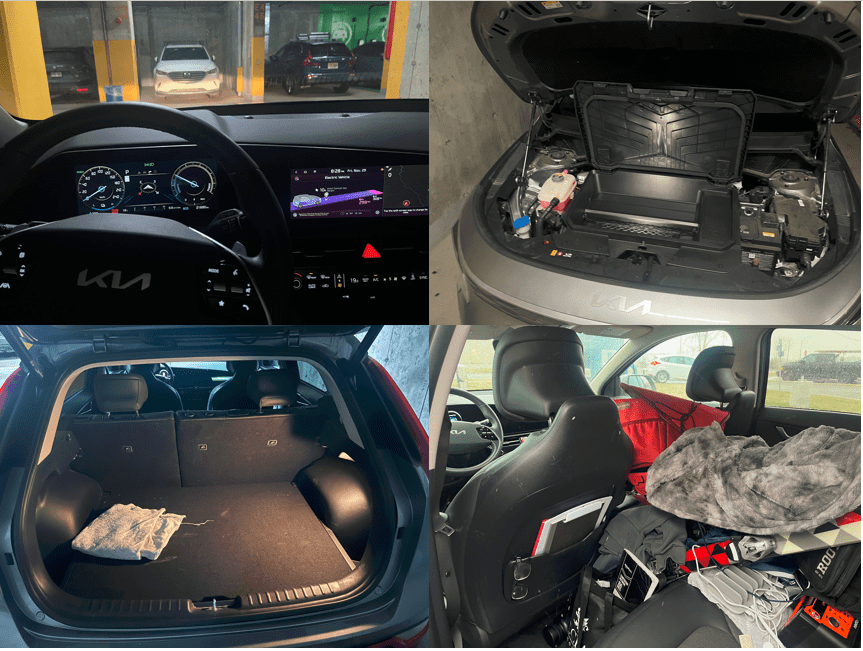
The interior was a mixed bag compared with the 2018 Nissan Leaf. While the infotainment system was easy to navigate, responsive and worked quite well. I missed seeing the battery percentage on the dash (there was a graphic “fuel-gauge” which I mistook for a battery temperature gauge for a moment). Door storage was a miss, I could not really fit my 1/2 l water bottles in there, which fit with ease in the Leaf. Also the seat-back storage for rear-seat passengers was just about useless, the firm plastic did not really allow for snacks, i pads, books and other “essentials” for my kids. The USB-3 plugs were nice, but hard to find. Also the kids had to make do without heated rear seats. But we did appreciate the flat-floor in the back. In the trunk, the floor is flat, to the edge, which some appreciate, but I have learned to love the deep trunk of the Leaf for its gargantuan capacity.
In fairness, if this was our car, we would have put the roof-racks on it (source). But alas, it was a rental, so things got a little cosy in the cabin. There is a small “frunk”, which can hold charging cables. This could be handy as it can be painful to drag the cables out of the back, particularly if they are buried in the sub-trunk.
Peering into my trip-log, and charging receipts. The whole trip took 8 hrs and 40 minutes getting to Tremblant, and about 8 hrs and 15 minutes getting back. Well, that certainly is a lot better than 11 hrs. Interestingly enough, the time spent charging is still about a quarter, which is comparable to my prior trips in the Leaf. But as the Kia E-Niro charges faster (session averages are about 45 kW for the E-Niro and 25 kW for the Leaf), we can also drive faster. In fact the drive time is about what is suggested by google-maps (about 6 and a half hours).
Price-wise, new it sits at about the same place as the Nissan Leaf near 45k CAD new. The used market has some inventory, and there has been some in my used EV surveys (source). It certainly will be a contender when the time comes to trade in my 2018 Nissan Leaf. Its interesting to compare it to the Nissan Leaf Plus. While the E-Niro charges faster, anything faster than 50 kW is hard to find outside the Tesla network. In fact of the 5 charging stops, only 2 were at stations that had the capability to charge faster than 50 kW. The interior I felt is more comfy in the Leaf, mostly owning to the useless door-bins and seat-back pockets.
 Electric car adventures
2 thoughts on “Driving the Kia e-Niro to Tremblant”