Recently I rented an EV from Hertz, the experience was fairly pleasant, but lets peer into my receipts, and see what we can surmise about the economics. From the renter’s perspective, is EV the better deal? As discussed, fuelling costs can be quite a bit cheaper with an EV (source). Assuming you can get an EV rental for a reasonable price, you might be going green in more ways than one. All-told, I saved about $100 when compared with a comparable gas car on my recent Tremblant rental run.
Lets start by looking at what is available from my local Hertz. I did check Enterprise and Avis as well, but they did not have EVs for rent, during my randomly picked dates in February of 2025. The following table outlines the vechicles as shown on the Hertz website (source):
| Class | Typical vehicle | Base price per day [CAD] |
| Manager special | Could be anything they have on the lot | $50 |
| Midsize | Toyota Corolla | $67 |
| Fullsize | Hyundai Sonata | $71 |
| Midsize SUV | Toyota RAV4 | $82 |
| Midsize EV | Polestar 2 | $92 |
| Tesla Model Y | Tesla Model Y | $91 |
| Tesla Model 3SR | Tesla Model 3SR | $108 |
| Minivan | Dodge Grand Caravan | $110 |
| Tesla Model 3LR | Tesla Model 3LR | $116 |
Well, interesting pricing, is all I shall say on that topic, but anyways, lets continue. My Kia E-Niro was rented to me for $73/day, but as it does not appear in their reservation system, it might have been a special that landed on their lot by chance, or perhaps a new offering not yet in their system.
Next we need to consider the fuelling expense, to do that, we need to make some assumptions on fuel economy, and energy price. To start we use the EPA test data reported in our used EV survey (source), then work in a scalar based on my actual energy consumption. As to Energy prices, this does get tricky, for example, on my drive to Tremblant, I was able to charge for free at my destination, but had to rely on pricy fast charging otherwise (0.7 $/kWh), as destination charging was about half of the energy I needed to get to Tremblant, lets cut that in half, and assume 0.33 $/kWh for the EV. Signs were up for $1.50/l for gas, so that’s what we will use there. This yields the table below:

As we can see, the EVs generally have lower fuel cost per km. The Dodge Caravan takes the cake as the most expensive per km rental, at 14c/km, and the Tesla’s are the cheapest at 5c/km. Now, much depends on how far you intend to drive. For shorter distances, even the costlier kilometres of the Midsize might be preferable, as the base price is much lower, while for longer drives, the base fee will be small compared to the per km fuel cost. I did promise a “heavy-footed”, scaling factor, which we add to the table. We found that we got 4.5 km/kWh instead of the promissed 6 km/kWh, mostly as we drove faster than the 80km/hr or so the EPA test cycle uses. So, we bump the per km cost up for all vehicles by that 33%, and compute the total for a 1200 km drive, 4 day rental.
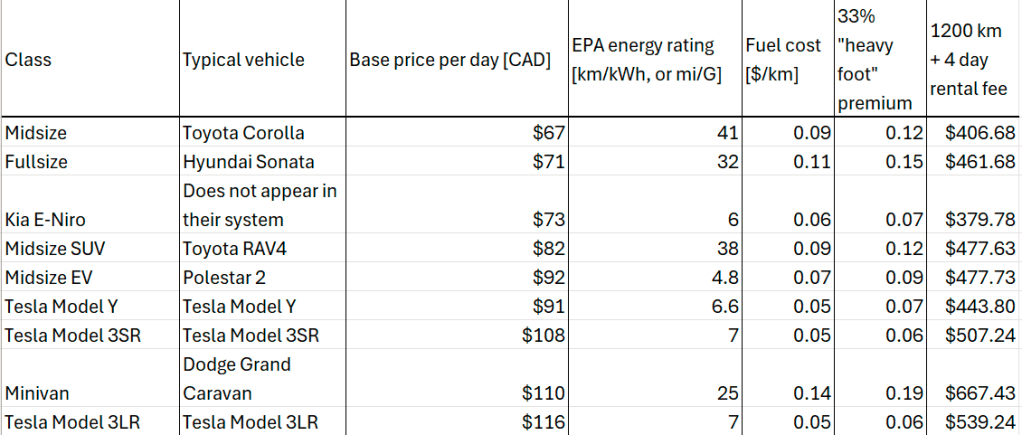
Well, the Kia-E-Niro is the cheapest at $379.78, quite a bit less than the $667.43 for the Minivan. Interestingly enough, the Teslas come out quite a bit more expensive, while being more efficient, the base rental fee is considerably higher.
I should also add that I opted for a few options when renting, which were not considered int he above table. Most notably I always choose what Hertz calls “Loss Damage Waiver” (source). Briefly, and very incompletely, the LDW is an insurance product that simplifies life in case of an accident. While comparable coverage is sometimes offered through your own car insurance, or credit card, the onus would probably be on me to figure all that out, and honestly, my time is worth more than that. The cost of LDW varies depending on presumably the cost of the car you are renting. I paid about $40/day for the Kia-E-Niro. This might tip the scales towards the cheaper Midsize car.
 Electric car adventures