I recently travelled to the Amazon. Given the geography (a big river), a cruise seemed the most sensible way to explore the Amazon, given the week we had over the March break school holiday. Being curious, I chatted with the kind and very knowledgeable staff which gave me an idea, why not put solar all over the top roof-deck? Lets explore this idea in more detail, we find that solar would not completely eliminate the need for Diesel, but would lessen the fuel bill enough to pay for itself over a few years, mostly ad Diesel is a very expensive way to generate electricity.
Indeed, the cruise industry has come under some scrutiny lately over its environmental footprint (source). Indeed, a chat with the crew revealed that our cruise ship burned 3000 l of Diesel a day. Just about all of that is converted to electricity, as these days, cruise ships are mostly propelled using electric pods that extend below the hull (source), plus given the warm Amazonian climate, there is no need for heating, hence that waste heat from the engine is just that, waste. Assuming 3 kWh/l that’s daily electricity usage of about 9 000 kWh/day (source).
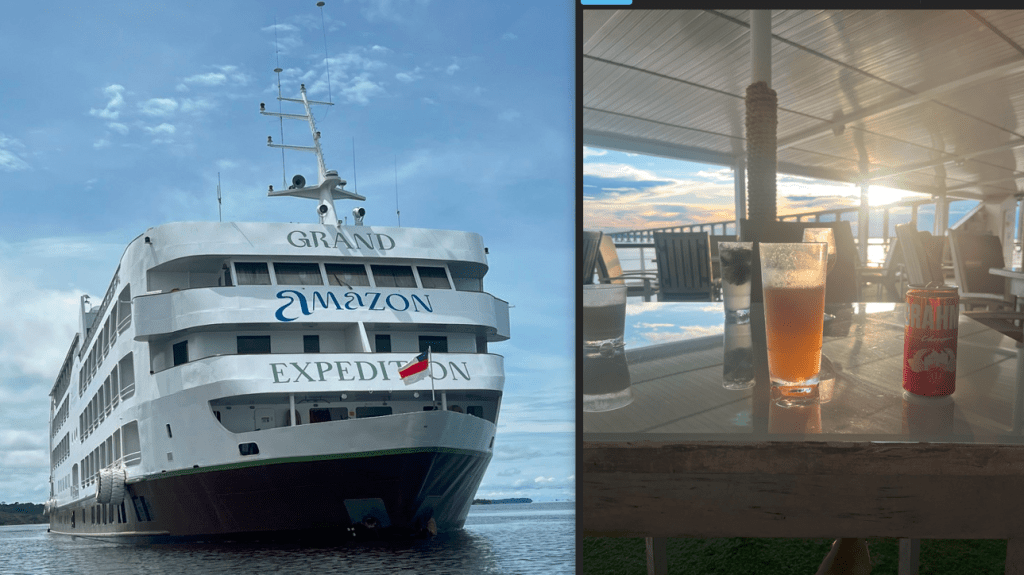
Half of the top deck is covered by a sun-shade (see photo above, above the beverages). It measures about 16 m wide, by 40 m long, which totals about 640 m2. The floor of the top deck is covered by a lovely green AstroTurf (works wonders on your feet), thus some reflection can be expected onto the underside of the sun-shade. This opens the door to bi-facial solar modules to replace the similarly thick roof-shade. Take for example, the Longi LR7, bi-facial solar panel, which is available with up to 610 W of solar, over its 1.1 m x 2.3 m area (source), this works out to be about 225 W/m2. Hence our roof-deck could provide 140 kW peak power, assuming we could fully cover the roof with panels.
Looking at solar irradiance numbers for Manaus Brazil (source), we can expect each kW of peak power to produce about 4.5 kWh/day to 5.5 kWh/day depending on the season. This adds up to production of 630 kWh/day to 770 kWh/day for our 140 kW peak power solar array, or 7% – 8.5 % of the 9 000 kWh/day usage. Lets pick 700 kWh/day as our average production for our economic calculations.
Economically, sings were up for $R 6.6 per liter of Diesel in Manaus Brazil. And as discussed above, we get about 3 kWh of electricity from that $R 6.6, so Diesel lands at about $R 2.2/kWh. How does solar compare? One W of installed solar in Brazil, costs about $R 2.93 (source), hence our 140kW solar roof, might cost the cruise company $R 410 200. This then produces 700 kWh/day or 225 500 kWh/year. Thus, in the first year only, we pay $R 1.8/kWh, so our payback period is less than a year!
There are some wrinkles, for example, Diesel generator efficiency is a function of generator load, hence some cleverness may be required, in order to fully realize the full potential of relatively cheap solar (source). A small battery system might nicely compliment the Diesel generators, allowing the generators to operate at peak efficiency. Further, its worth noting that since the solar system produces relatively few electrons given the ships needs, micro-inverters might greatly simplify the installation. Other projects, say adding reflective film to windows, or upgrading door seals, might have similar payback periods but are much less costly to install (source). Further air conditioner efficiency upgrades might similarly be well worth it, all of this comes from the fact that Diesel is an expensive way to generate electricity.
 Electric car adventures