Recently, we discussed the economics of rooftop solar (source). Briefly, at $3.25/Watt peak, it winds up being a break even proposition, with anticipated energy bill savings, paying for the system over its expected life. But could we somehow, do better? If rooftop solar were to be had for closer to $1/Wp, then the cost per kWh would be closer to $0.05/kWh. Lets peer closer into my invoices, and see how the cost breaks down for my rooftop solar.
I recently installed a 11.34 kWp solar system on the roof of my house. Looking at my invoices, and doing some googling, we arrive at the following table outlining likely cost contributors to my project, we have normalized these numbers by the installed peak capacity.
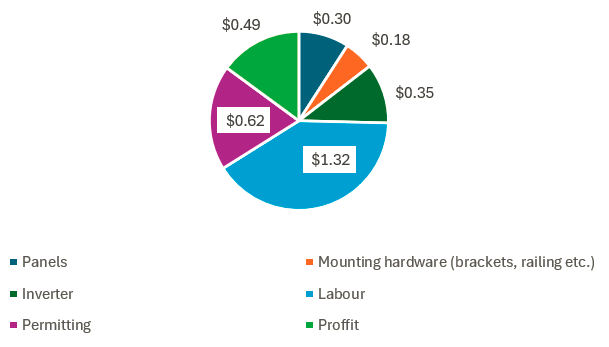
Hardware cost (mounting/panels/inverter) came from frankensolar.ca, permitting was estimated by reviewing my first deposit invoice, and adding a small allowance for a permit from the electrical safety authority (ESA), for electrical work (that is usually obtained later). Labour was trickier to estimate, some chatting with the solar crew revealed that they were often former roofers, and it so happens that my roofing invoices were split, payment for materials was separate from labour, which allowed me to estimate labour expenses. While roofing is very different from solar panel installation, I found the two jobs both required about 7 man-days of work each, suggesting similar labour costs between the two.
I find it interesting that the panels themselves, are a relatively small cost of the overall project, the panels and the inverter accounted for about 20% of the overall budget. These two are essential. Labour and mounting hardware I suspect could do with improvements, integrated mounting solutions are one path forward that is being explored (source). The solar crew spent a fair bit of time working on the mounting system, attaching rails to my roof, spacing them sensibly etc. Anything that speeds up the cost of construction, and or lowers the cost of the mounting hardware, would be helpful to lower these cost components.
Permitting strikes me as an easy avenue for progress. For example, a building permit was obtained by the solar installer, along with a structural engineers report on roofing loads associated with the solar system. However, these reports revealed that the solar panels are only about 15% of snow-load. I suspect that 15% is easily eclipsed by other factors, say different types of wood might have variations that exceed 15%, slight manufacturing variances in the exact dimensions of the wood, slightly more or less glue/nails and other materials, and so on and so forth. While 20% for permitting, is not completely out of touch for building projects (source), compared to 0 for my roofer, it seems excessive.
Another idea is to simply use more efficient panels. Since the cost of the panels themselves is a relatively minor cost component, I certainly could spend a bit more on the panels, get more “watts” and hence lower the dollars per watt metric. But there are limits, making the panels bigger is not really possible owning to my roof geometry, but there are panels out there, that do a bit better than the 205 W/m2 (source). For example, the REC Alpha Pure RX series has a panel that manages 225 W/m2, about a 10% improvement (source). There are some improvements on the horizon, the world record would correspond to perhaps 500 W/m2, with time, that might work its way into the residential solar market (source).
So, looking to the future, $1.5/Wp certainly seems plausible, looking at more efficient panels, more sensible permitting and some clever mounting strategies.
 Electric car adventures