My solar panels came online recently, and with it, lets look at what has happened to my power bill. Net-metering is not available yet, as my kit is new on the market, which has resulted in some permitting delays, nevertheless, I figured Id share my experience with my battery/solar configuration, as recent incentives from the Ontario Government nudge people away from net-metering.
Briefly, my electricity bill is almost exclusively “ultra-low-overnight” now, before any of this, back in April of last year, I paid $156, while this year, I paid $77, why thats half off, bringing my bill closer about $30 from the theoretical minimum, which would be the customer charge of $47.77. Lets take a closer look at the components of the bill.
| Item | Last year April | This year (battery + solar) | Reduction % |
| On-peak weekday | 94 kWh ($26.88) | 4 kWh ($1.23) | 96 % |
| Day-time/weekday | 266 kWh ($32.45) | 68 kWh ($8.33) | 74 % |
| Day-time/weekend | 126 kWh ($11) | 17 kWh ($1.33) | 87 % |
| Overnight | 575 kWh ($16.11) | 300 kWh ($8.39) | 48 % |
| Delivery charges | $26.52 | $9.77 | 63 % |
| Customer charge | $47.77 | $47.77 |
The largest reduction is on the on-peak rates, which are the priciest at $0.3/kWh. Daytime usage is also sharply down, while overnight usage has declined less.
Much of that has to do with shenanigans on my behalf. The battery system has been informed of our electricity tariffs and usually powers the house through the peak hours. Further, we have reconfigured out hot water tank to load up during the day, when the sun is out. Similarly the heat-pump has been re-configured to start a little later in the morning, when the sun is out. All of this is to try as much as possible to use our solar, as it gets curtailed if there is no place for the energy to go.
Normally this would be exported to the grid, and with time we will have that ability. It is not unusual for solar projects to have a short delay between installation and export permission (sometimes called permission to operate), as the necessary approvals and permissions wind their way through the system.
This does gives us some data to answer the question if the new Ontario solar and battery incentives are worth your while. Again, much depends on your exact goals, personally I’m more in it for climate reasons, hence I would probably export, even if I got very little in return. Plus there is power resiliency, as both me and my wife work from home.
Briefly, for us, the power-bill is about $150 a month, as we saw, our solar and battery system can cut that in half to say $75 a month, while exporting would likely trim that further to say $50. Further, we have had a few months, where only the battery was installed, in our experience, the peak charges are covered by the battery, as well as some of the daytime usage. Hence, we wind up with a power bill of around $125 per month. Doing the math, we arrive at the following figures.
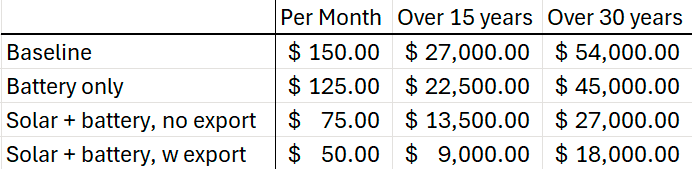
Indeed, solar and battery generate significant savings over the life of the system (15 year minimum, possibly 30 years). And if one assumes a 30 year life, then the incentives ($10k) are borderline worth it (see this post). Its encouraging to see that the anticipated savings over 30 years will pay for the solar system (although I may need to stretch my assumptions to cover the battery storage system, which given the anticipated increase in usage in Ontario, may not be much of a stretch (source)).
 Electric car adventures