Lately, while travelling, I bumped into a fellow EV driver queuing at a EV fast charger. This was on a Sunday, and our friendly EV driver was charging up for the week. I did ask, if they had the ability to charge at home, “but I get free charging at this fast charger” came back the reply. Seems a bit flawed in my mind, mostly as the cost of charging is relatively small, and the convenience of home charging is huge. Lets discuss this, and other fallacies from the gas-car world that do not translate well to EVs.
Gas cars vs EVs. Lets start with some basics, the gas car generally gets further on a full tank, compared to the EV on a full battery. But there are MANY more opportunities to charge the EV than the gas car. Sure, there might be more gas-pumps than ultra-fast electric car stations, but surely there are way more electrical outlets out there than gas-station-pumps, each and every one of them can charge your EV.
Gas-stations are generally more reliable than public charging stations. During my gas-car driving days, once a year there was a problem, usually involving me trying to use an expired credit card, but sometimes I had to use a different pump. In my EV days, Id say about once or twice a month there is a problem. Usually involving some payment issue (no money in the account being the usual suspect), but broken charging stations happen too.
With that, lets explore some habits that may not work as you go electric.
Driving til empty. My brother typically drives his gas car until the needle is hovering just above empty. If you charge your EV at home, and you are heading home, that’s fine. Otherwise, you might want to leave a little buffer, as public charging network might let you down, plus, if your car is parked, it could be charging.
Worrying about range. Range remains top of mind with vehicle buyers, and is frequently quoted in various surveys related to EVs. Strangely enough, we look at what cars are actually used for, its very short journeys, 93% being less than 50 km, something that my 2015 Nissan Leaf could do with ease. We tend to focus far to much on that 7%, than the 93%.

Going for the fastest charger you can find. While surely 250kW is faster than 6kw, actual charging speed will vary depending on your EVs situation (primarily state of charge and battery temperature), plus the charging station sometime throttles down as sometimes charging infrastructure is shared with several charging plugs.
Rather, think about how long you will be there, and how much charge you need to get to where you are going. Sometimes the answer is I just need a little top-up, why not park and use the unloved L2 charger while you enjoy lunch, by the time the meal is consumed, the dog is walked, and the kids are tired, Ill have what I need to continue my journey.
These days, here in Toronto, there are lots of neighbourhood L2 charging stations (source). Perhaps your city has something similar. A neighbour who is currently renovating their garage, drives a kilometre or so to one of these, plugs in, then walks the dog back home, does some chores around the house, then walks the dog back in the afternoon to retrieve his fully charged EV.
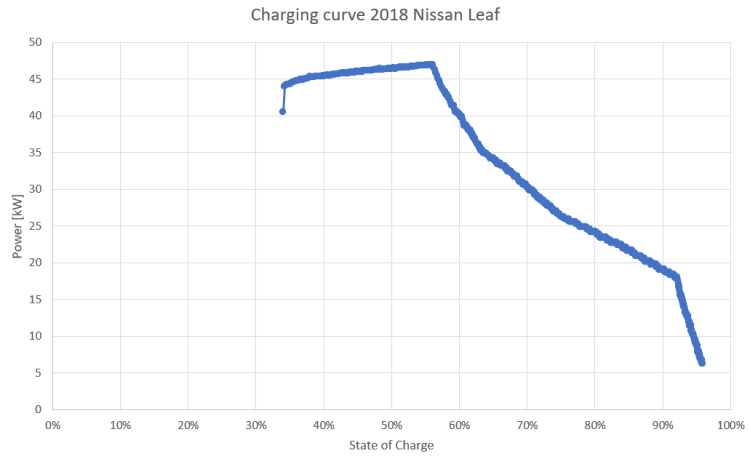
Filling up to 80%. That last 10 %, is quite slow on a fast charger, while the first 10 % is much faster. On my 2018 Nissan Leaf, I get more than 40 kW until about 55 % state of charge, thats about 5 times what I get when I am above 90%. Most EVs slow down quite considerably as the state of charge exceeds 80%. I find my Leaf is tolerable until about 90%. Hence a better strategy on a long journey, might be to stop more often, and not charge above 80%, also, why hog the fast charger if you are not leveraging the charging power?
Charge at home if you can. To be fair, sometimes you cannot charge at home, a renter in an apartment building may not be able to install a suitable outlet where they park their car. But more often than not, there is an outlet near where you park, you do have to be careful here, as most domestic North America outlets have a hard time supplying more than 120V, 10A ~ 1.2 kW, but that is often all you need. Naturally if you do not own that outlet, or at least pay that outlet’s power bill, you need to obtain permission to use it. Better yet, if you can, install a charging station where you park, compared to the car, its a lot cheaper and allows you to get lots of value from your investment.
Highway driving is not more efficient. EVs work different than gas cars. Regenerative braking works very well in stop and go traffic, and the generally slower speed of in-town driving, means there is far less aerodynamic drag, hence city driving tends to be more efficient than highway driving.
Indeed, life with an EV is different than a gas car. Generally, longer journeys (~350km + for my EV), are a little more painful, while the majority of my journeys are short putts around town, where the benefit of charging at home are very much appreciated. Overall for me, thats a win.
Buy Used. Here is one habit that carries over to EVs just fine, there is lots of value in the used market. My 7 year old Nissan Leaf can still manage its EPA rated range of 250 km, yes I do have to drive a little slower, but the battery is still 90% of new. These days, you might get one for 5k, about 10% of what a new one cost back in 2018, thats lots of value to me.
 Electric car adventures