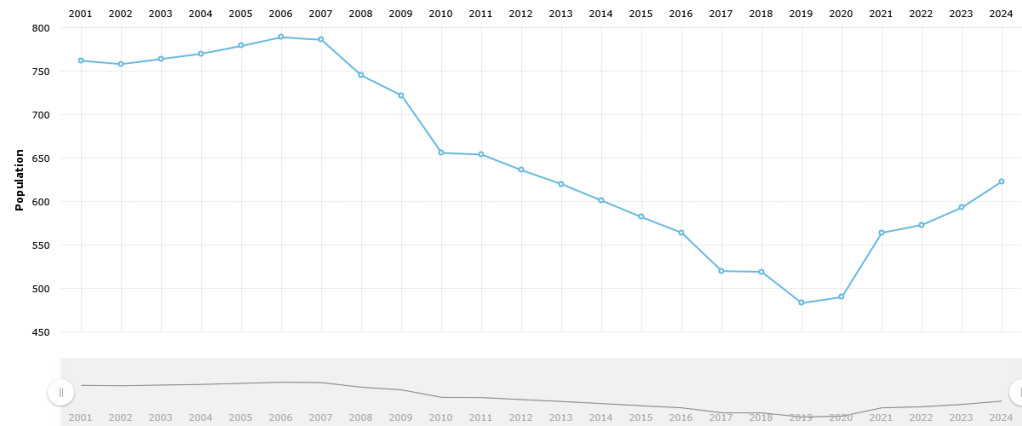
About a two hour drive east of Edmonton, AB is the town of Hardisty, AB. Vast majority of Alberta’s oil goes past Hardisty on its way to markets in Ontario, Quebec and the US Mid-west. By some estimates, $90 B/year worth of oil moves through the town of Hardisty. Yet it is a town in decline, population is still only 80% of what it was in 2005 (source). Some of that is due to the Oil industry and how it works, in particular how few it employs (it employs only 0.3 % of Canadians, yet delivers 3.2 % of GDP (source and source)).
Hardisty is a productivity marvel. It is really remarkable how efficient the Hardisty tank farm really is. It takes 15 full time employs, to move $90B worth of oil per year (source, source). They may need some 200 contract staff from time to time, but it is amazing that 15 people can move $90B worth of oil per year! Why that is $450 M per worker per year, amazing.
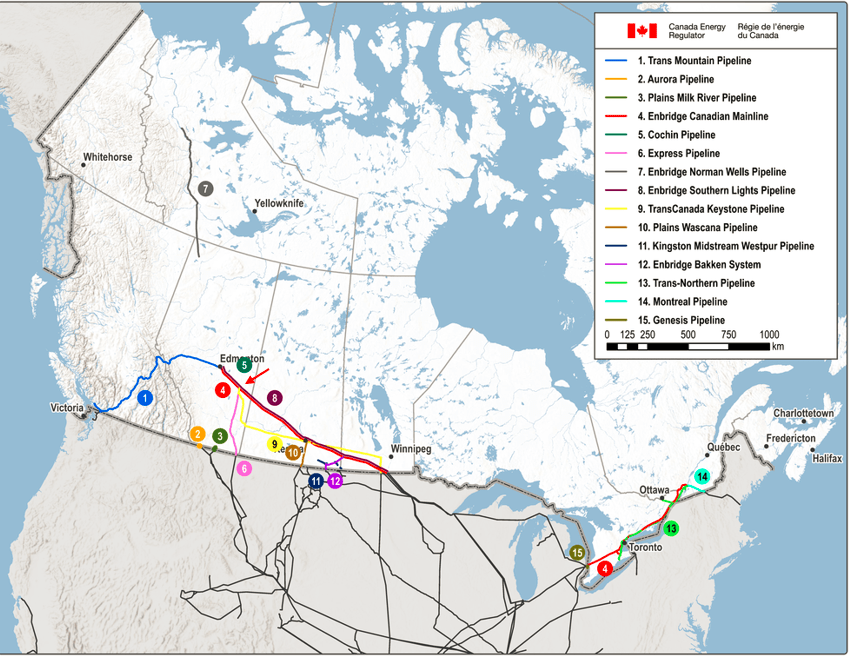
Contrast that to say the 401, the highway that runs from Windsor, ON to Quebec. It has at least 10 000 trucks driving on it every day, moves about $200 B worth of goods every year (source, source). Each of these trucks needs a driver, sometimes two, plus perhaps another full-time-equivalent (FTE), helping with unloading and loading, why that gets us to 30 000 “jobs” which move the aforementioned $200 B worth of goods per year, thats $6.7 M of trade per worker, a tiny fraction of Hardisty’s productivity miracle of $450 M of trade per worker.
So why is Hardisty not like say Windsor ON (population 220 000), London ON (population 400 000), or even Bellville ON (population 55 000) (source)? Hardisty has a population of about 700 people, and in 2015 it was as few as 500 people, see chart below.
Some of it is by design. Oil industry executives are keenly aware of “the WTI vs WCS discount” (source), and are working very hard to ensure Alberta’s oil is at or near the same price as that of Texas. One of the reasons for this “discount” is transportation costs. Alberta’s crude must be transported thousands of kilometers overland, while there are lots of facilities in Texas to load crude onto tankers, which are very efficient. Hence to minimize the “discount”, you need to minimize transport costs, which often means trying to do this with the fewest jobs possible.
Recent by-election for a seat in the Canadian house of commons put the spotlight on the riding of Battle river-Crowfoot the home of Hardisty, AB. If you can stomach Mr. Poilievre’s politics, this video is worth a look. While I am no fan of Mr. Poilievre, good data can come from anywhere, and his quoted figure of Hardisty, AB moving $90B/year of economic value by a small town of 650 people is incredible.
There is a larger lesson for policymakers, if jobs is what you want, oil pipelines are a lousy investment. Yes there will be construction jobs, but after that, only a handful of people are needed to move all that oil.
 Electric car adventures