As long as there have been automobiles, buyers on a budget, have always faced a dilemma: Should I get yester-years flagship, or buy a new(er) mass market brand? Looking at our last used EV survey we see a similar trend. Your 30k could get you a 2024 Nissan Leaf plus, or a 2016 Tesla model X, as an example. Lets discuss some of the pros and cons. Briefly mass market brands tend to have both cheaper and more available spare part supply, while specifications might point towards the yesterday’s flagship.
Lets start by reviewing our fall 2025 EV survey. As we can see, there are quite the selection of EVs, including a brand new Fiat 500e.
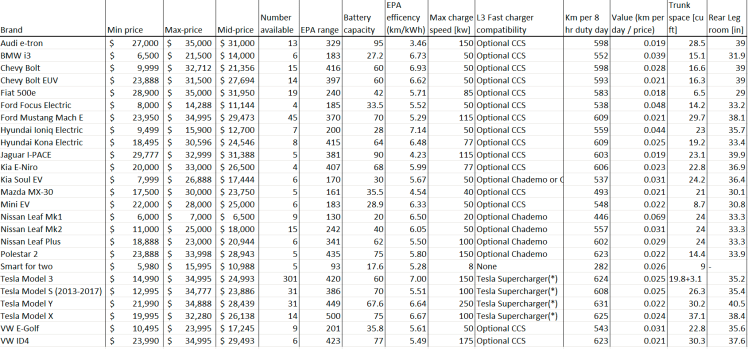
Lets have a second look at Autotrader to see if we can get some idea of how old these things would be, we also narrow our pricing range to 30-35k. In the admitetly arbitrary “luxury” category we have the following examples.
| Brand | Model Years | km driven |
| Audi e-tron | 2019-2022 | 65k-130k |
| Jaguar I-Pace | 2019-2020 | 60k-90k |
| Tesla Model S | 2017 | 90k-100k |
| Tesla Model X | 2017-2020 | 150k-220k |
While the “mass-market” category offers the following examples.
| Brand | Model Years | km driven |
| Fiat 500e | 2025 | New |
| Ford Mustang Mach E | 2021-2023 | 30k-80k |
| Hyundai Ioniq 5 | 2022-2023 | 60k-100k |
| Kia E-Niro | 2023-2024 | 20k-50k |
| Nissan Leaf Plus | 2024 | 10k |
| Tesla Model 3 | 2021-2023 | 20k-90k |
| Tesla Model Y | 2020-2021 | 80k-150k |
| VW ID4 | 2022-2023 | 10k-70k |
Seems our mass-market category has cars that are perhaps 3-6 years younger than what you might find in the luxury category. Further, the luxury category has perhaps 100 k on the odometer, while the mass-market includes new cars.
All this likely means a heavier maintenance burden on the older more driven luxury cars. Of note, many EVs have a warranty period of 8 years, thus you may likely be on your own if you opt for the luxury category, even if you went with a brand with a dealership model such as say Audi, the maintenance bill will likely be higher.
But the specs might be nicer on the luxury side, take battery size for example, the 2019 Audi E-tron has a 95 kWh battery, something you would be hard-pressed to find in our mass-market category. Further, the luxury brands are all roomy SUVs (with the exception of the Tesla Model S), while the mass-market brands are generally smaller cars, and yes, there is even the very compact Fiat 500 e.
While the luxury brands might be more tempting looking at the specifications, they do carry a heavier maintenance burden, pronounced doing several weekends of various DIY projects tending to the little things that start breaking (think door locks, parking break tension etc.), or a pricey trip to the dealership.
Ultimately, it is nice to have choices.
 Electric car adventures