Should battery systems be able to export stored energy during peak hours? Even if that energy originally came from the grid during off-peak hours? Welcome to the world of brown exports, we discuss some of the issues involved: Should you configure your system to do brown exports? Are you allowed to do so by your utility? What are the expected economic benefits?
In order to be able to export energy from your home energy system, you need to have permission from your utility to export electricity to the grid. Here in Toronto, you need to have solar in order to have permission to send electricity to the grid, usually via a “distributed energy resources” arrangement. Further you need a battery system to be able to technically do this. Hence, brown energy exports, should be discussed as part of a solar and battery installation.
Having recently done just that, for you my dear reader, I reached out to my utility (Toronto Hydro), more specifically their distributed energy resources division, as there is some ambiguity in the language on their website. I got back an answer I interpreted as “not a no”, and contacted my installer to discuss technical specifics. As it happens, my installer can configure my Powerwall 3 to permit “exports from the battery”, in their service app, so we decided to try.
In addition to enabling battery exports, you need to ensure that your battery is allowed to charge from the grid, when power prices are cheaper. Naturally ensure that your solar and battery system knows your power plan, as it will be essential to know when power is cheap and when it is expensive.
You should also think about if brown exports is something you want to do. My 13.5 kWh powerwall, is configured to use 80% for “time-based-control”, this gives us approximately 10 kWh of play. Looking at the ultra-low overnight rate pricing. The best value for those 10 kWh is to displace peak-usage 47c/kWh, the second best thing is to export (or sell) at 39.1 c/kWh during peak hours. Hence if my home battery can just about cover my peak usage, it makes little sense to do so. In my case, about half the 10 kWh usage covers my own usage, hence there is something to be gained here. Its certainly better to get 39.1 c/kWh than the third best thing (displace usage during mid-peak hours at 20.6 c/kWh).
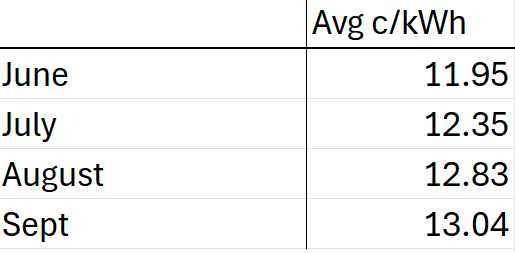
Given we are now entering the winter months, hence solar generation (and the associated credits that come with it) is likely to reduce, it will be interesting to monitor the impact to my power-bills, as brown-exports are likely to increase “value-per kWh” which could be handy as the number of kWh generated is likely to reduce substantially as winter sets in. It will be interesting to see October and November value per kWh, and how it compares to what we have gotten currently.
 Electric car adventures
One thought on “Brown energy exports?”