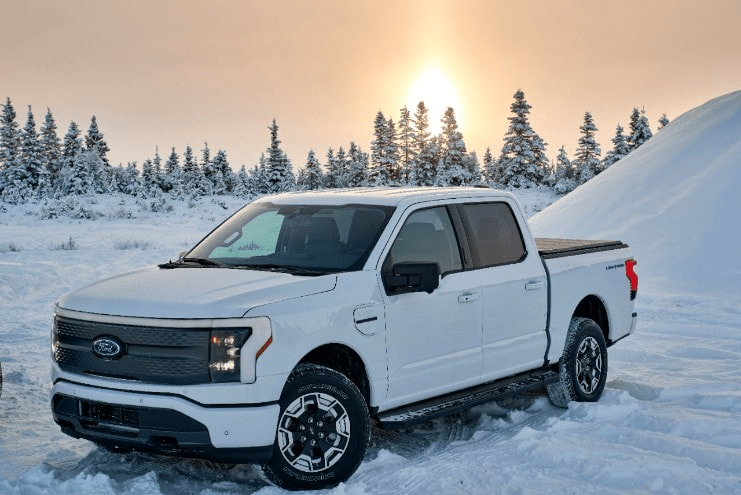
Word came in mid December of Fords decision to cancel the F150 lightning. While it has always been too big and too expensive for my taste, it served as an interesting aspirational EV, showing the world that yes you can power your home for days with your EV. Let’s discuss Fords reasons, why I think it is a mistake, and also the implications on the wider EV scene.
Let’s start with the obvious. Worldwide the Pickup is a North American thing, three out of every four pickups is sold in North America, and most of those in the USA (source). As the very generous tax incentives for new EVs came to an end last October that 65k-90k sticker price of the Lightning became tougher to swallow (source), when compared with the 47k-81k for the combustion version (source). If you really wanted one, you might have bought it in September, hence November sales data looked bleak at 1006 units, compared to almost 4000 in September (source).
It is a bit premature to speak of a sales crash, after all, we have had perhaps one quarter of sales data after the end of EV tax incentives in the US (source). When these programs end, sales data gets really funny. Just before they end, there is a big sales bump as people who are on the fence make their move. In the months that follow, since there is nobody on the fence, there is a sales slump, followed by recovery (source). Montly F150 lightning sales data supports this, with a modest recovery in December to 1500 units (source).
I have always admired Jim Farley, Fords CEO as a down to earth level headed leader in an industry faced with many of a crisis. But I wonder if this is a bit of an overreaction, after all, Ford might have spent $20B devleoping the lightning (source), should one not try for more than four years, given the investment? While it seems clear that the lightning never managed more than a few percent of F150 sales (source and source), there is still money to be made.
In fact there were a few easy moves on the table for Mr Farley: Do a low cost refresh towards the electric success on the pro side (source), drive cost out, skip 2026, and fix the whole whole home integration situation.
Let’s start with that last bit. Ford’s home integration system allowed your home to powered by your truck (source), at least in theory (source). Complaints are rife, software update crashed the system (source), communication problems, and so on and so forth. Google the terms “F150 lightning home integration system problems” and you get a very long list of problems (source). Surely a few million bucks would go a long way to fixing these issues. After all, that 10-20k F150 lightning price premium discussed above is less than what I spent installing a home battery system, that has 10% of the battery capacity! Talk about a missed value opportunity.
Cost-out is another tried and true path in the automotive world. Surely Ford could have chipped away at that 10-20k price premium? A lot of the Lightning parts are common with the F150, there may also be part sharing with the Ford Mach E (source) that could be expanded. Surely new battery tech has come around that might offer some cost savings (source).
There is also the Volkswagen path, why not pause production for 2026 giving EV sales in the US time to recover? This is what Volkswagen did for their ID Buzz in the US (source).
Since the Pro side of Ford has been doing well EV wise (source), why not expand on that? Take for example the power company line fixing truck, that has a basket with very complicated looking hydrolics to move it around. Surely a F150 lightning based version could leverage the power-ports in the truck bed to make life easier for those hardworking line crew? The F150 charging speed could do with improvement, that may not be too expensive to do, going from 150kW to 250 kW is quite doable, other “400 V” cars like Tesla and Rivian manage it somehow.
Some have suggested that cancelling the F150 lightning has more to do with politics than anything else (source), a bit of a “kiss the ring” situation if you will. If the idea is cheaper “plug-in-hybrids” having the Ford Ranger PHEV on sale everywhere except North America seems a bit wierd (source). Others have suggested that cancelling the lightning is more of a “stop-the-bleeding” move, conserve cash to spend on developing a better truck (source). Perhaps, but there is an aweful lot of learning Ford is going to miss out on.
Which brings us back to politics. If that is Mr. Farleys reasoning, cancelling the F150 lightning is a very short term motivated move. If for nothing else, every EV cancelled is one more win for the Chinese, and Mr. Farley was right, these Chinese EVs are really good (source). Its also kinda hard to convince people of the merrits of high tarrifs on Chinese EVs if the locals are not making a comparable EV. There have been court cases that killed tarrifs because of lack of comparable domestic products (source). A better move might have been to try to find a better market for the F150 lightning, perhaps all these line trucks would be a good place to start.
 Electric car adventures