Imagine you bought yourself a nice new Tesla Model 3 back in July of 2023, you might have splashed out $85k CAD for a performance variant (source, and source), these days, in early 2026, one can be found for $35k on autotrader. That is a 60% drop over two and a half years, quite the deprieciation. We at electriccaradventures have long advocated for you my dear reader, to simply buy used, seems you can, with a little patientce, get 60% off that way. Lets discuss depreciation, particularly factors that are unique to EVs.
Cars like many other things in life, depricate. Electric or combustion, makes little difference, there is just something about that new car smell. In fact, just driving a new car off the lot, depricates the car by 10-15% (source). In the first year we can expect 20-30 % total deprication, while after two years it might be 30-40% (source). If this is a luxury car, expect steeper depreciation, after three years we might be at 50% (source).
EVs also received incentives. Here in Canada we used to get $5k CAD (source), while our friends to the south might have managed double that come tax time (source). Both programs are likely history, although there has been some chatter about a return in Canada (source). Whatever happens, this adds depreciation pressure, why pay $85k CAD for something that just drove off the lot, when you can get a new one for $80k CAD (85k CAD purchase price – 5k EV incentive = 80k)?
Technology has been improving as well, this can add to depreciation concerns. While battery size has stabilized for the most part (see chart below), and thus range, other specifications continue to improve, most notably charging speed, the new leaf for example now has 150kW charging, compared to 50 kW for the 2018, or horrors, 20 kW for the 217 (source).
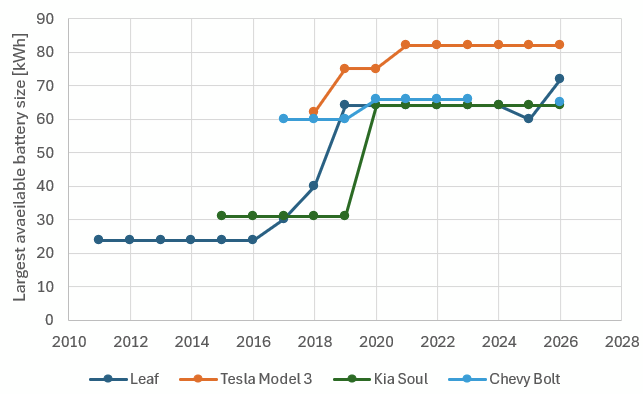
Many used car shoppers are concerned over battery degredation (source). While in practice this has not really been an issue (source), the concern seems very real, and hence, another push on that depreciation lever.
So why did that Tesla Model 3 lose 60% of its value in just 2 and a half years? Well, at the same time, mass market cars lost 30%, luxury cars 40%. That EV incentive, well, since my source quotes US pricing, thats another 10% gone, and figure another 10% over newer technology (the Model 3 did get a refresh back in 2024), and figthing for scraps might be concerns over battery health of that Model 3.
 Electric car adventures