Had a chance to have a peak at the new 2026 Nissan LEAF during a charging stop, in my trusty 2018 Nissan LEAF. The new version rides taller than its predicessor, it is now firmly in crossover territory. Like its predicessor, there are two charge ports, a J1772 for L2 charging, and a NACS port for fast charging. Specifications are much improved, with more range, faster charging and at long last, a cooled battery pack. The new LEAF provides a competitive package for Nissan to stay in the game, if priced well, it might allow Nissan to regain the sales lead.
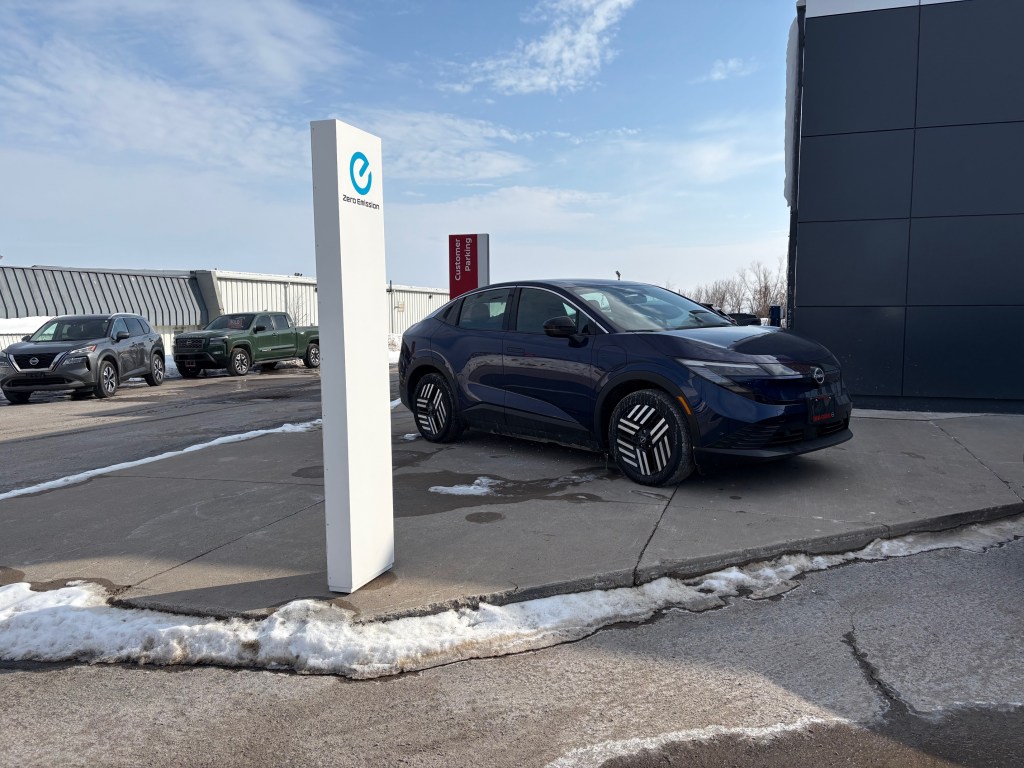
Car manufacturers are increasingly finding themselves in a transition phase. Gone are the days of building electric vehicles (EVs) exclusively for early adopters, to keep sales numbers acceptable, one must cater at least partially, to the mass market. Plus, from a specifications standpoint, the 2025 LEAF was quite far behind, hence the need to refresh, and the introdcution for the 2026 LEAF. Lets have a peak at the specifications, and compare to a few of its competitors.
| 2026 LEAF | 2025 LEAF | Tesla Model 3 LR | Hyundai Kona EV | Chevy Bolt LT * | |
| Battery Capacity | 75 kWh | 60 kWh | 85 kWh | 64.8 kWh | 65 kWh |
| Charging speed | 150 kW | 100 kW | 250 kW | 150 kW | 150 kW |
| Price [MSRP] | $47,857 | $47,498 | $59,990 | $43,999 | $43,443 |
| Range (EPA) | 488 km | 341 km | 584 km | 420 km | 422 km |
| Charging connector | NACS, J1772 | CHADEMO, J1772 | NACS | CCS | NACS |
Indeed, the 2026 LEAF is very much improved, gone is the problematic CHADEMO connector, replaced with a much more available NACS connector (also known as the Tesla plug). Range is much improved, by 147 km no less, bringing it in linne with its competitors. The two charge connectors (NACS, J1772) is an interesting choice, but where I live, it makes a lot of sense. Native supercharger access is nice on road-trips as the Tesla supercharging network consistently ranks highly in user satisfaction surveys (source), but the J1772 is far more popular for L2 charging than the Tesla plug (250+ vs 85 according to plugshare near Toronto, ON).
The price, MSRP of $47,857 is still problematic. While in-line with its competitors, it is still high for the mass market, the 2026 Kona with a gas-engine starts at $26, 749 MSRP, while you need to fork over 62% more for the EV version. For now, while Nissan works out the manufacturing kinks, that is probably fine, but they better have a plan to sell one for closer to $25k in the comming years. At that price, it would be a much more tempting package for the mass market shopper.
 Electric car adventures