The battery in my EV is 3-4 times bigger than the one in my home battery system. This could make quite the difference, in a prolonged power outage, that 3-4 times capacity sure would be nice. Lets explore some options for how my EV would be connected to the grid. Briefly an EV can be connected on the AC or DC side of your home energy system. Let’s get into it.
Lets start with a typical schematic of my home setup, including the battery and solar system, as well as how these connect to my EV. Many EV owners do not have solar, or a home battery system. Or as in my case, I got the EV before I went solar. In such a case, there is no “DC” side to tap into, and the only way to charge my EV is via an AC charger.
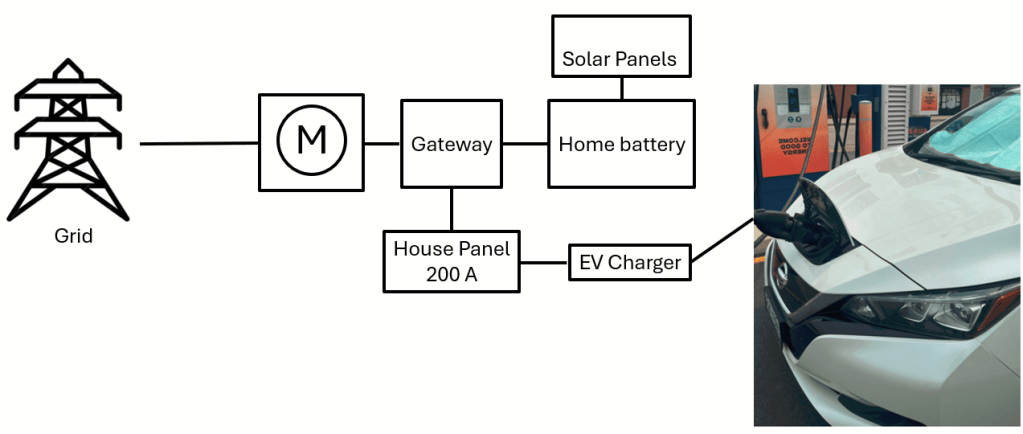
Here only the home-battery and the solar system are “DC-side”, and the DC-AC converter is located within the home battery. Several vendors have likely taken this approach. My home battery is a Tesla Powerwall 3, if I were to get a Tesla that supports powershare (thats a no on the Cybertruck b.t.w. too big), the car will leverage its inverters to provide AC power (source). Same with the Ford home integration system (source). Lets call this arrangement AC side EV connectivity.
Generally this is a much simpler arrangement, your EV likely has an inverter that could be borrowed. Hence only minor changes are required to the EV charger to permit bi-directional AC, along with low cost command and control to ensure the home battery and the EV are getting along.
There is a problem though, each pass through the AC-DC or DC-AC converter involves losses of 5-10%, hence “round-trip efficiency” of charging your EV over AC at night, then discharging during peak hours say, would involve compounded losses.
Further, some regions really care about the total capacity of all inverters that could shift power to the grid. In my case, thats 10 kW in the home battery, as well as 6.6 kW in the EV, for a total of 16.6 kW. This creates a problem, as permitting for grid-connectivity where I live in Toronto, is much easier if the total inverter size (16.6 kW in this case), is less than 10 kW (source).
So, is there another alternative? As it happens there is, SigEnergy has a product on the market where the EV charger is DC side (source), as does Dcbel (source). This yields a diagram slightly different from the above like so,
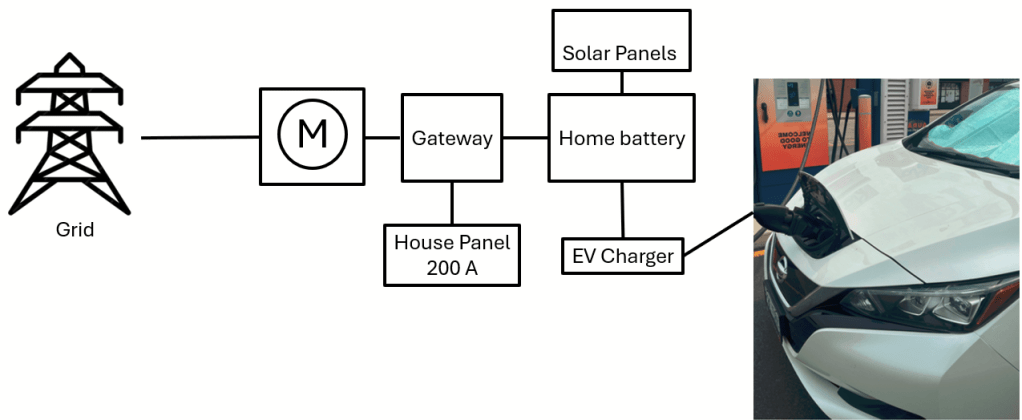
Now, the “sum of all inverters” is just the 10 kW inverter in my home battery. Plus, since the charger plugs into the DC port on my EV, it can charge a lot faster, 25 kW vs 6.6 kW. Also, as things stay DC side, I may not be subjected to compounded conversion losses.
I must say I am tempted by the DC side connectivity myself. Mostly as my utility Toronto Hydro, really seems to care about “the sum of all inverters” situation. Hence having to derate the home battery and or the EV generating capacity may only allow my home to draw 5 kW in a powercut which is low enough to be a problem. But that would involve replacing my home energy system, something Im not quite ready to do.
 Electric car adventures