Soon after the second generation Nissan Leaf came out back in 2018, there was the expectation that the new Leaf could take long road-trips “just-like-any-other-car”. Not so fast it turns out. users started to report slower than expected fast charging speeds on long road trips, and #rapidgate was born. Lets dive in and take a closer look at what #rapidgate is. As we will see, living with #rapidgate is easy, its all about managing battery temperature, and if need be: slow down, charge more often at higher SOC, and keep the cabin as cool as you can.
#rapidgate took on a life of its own back in 2018, there was lots of coverage of users waiting frustratingly long for their Nissan Leafs to rapid charge as they got closer to their destination, particularly in warmer climates with generous freeway speed limits. See for example https://www.greencarreports.com/news/1116139_2018-nissan-leaf-electric-car-is-there-a-fast-charging-problem, https://www.youtube.com/watch?v=CNY2xdWaGiQ and https://mynissanleaf.com/viewtopic.php?t=26049 and https://www.youtube.com/watch?v=T00TveCh-_w. The main symptom? Slow rapid charging, caused by the car throttling charging speeds to prevent battery overheating. Reports surfaced of drivers waiting hours to “fast charge” their cars when battery temperatures exceed 50 C (see https://cleantechnica.com/2018/07/16/2018-leaf-vs-long-journeys-can-it-take-the-heat/).
So living with #rapidgate is all about managing battery heating. “You can’t manage what you can’t measure” goes the old saying. Thus we begin by discussing how to monitor the battery temperature. On the first generation leaf, the battery termperature is displayed along the left side of the display. For the second generation Leaf (2018 and later), you need to navigate to the left-most display option, down to the Battery Temperature screen to monitor the battery temperature.

Ideally your battery temperature should be near the middle, which corresponds to about 20 degrees C. If the battery is too cool or too hot, power transfer is limited which manifests itself in slower DC fast charging, less regenerative breaking and some limits on acceleration. Managing #rapidgate is all about keeping the battery temperature from creeping into the hot (or red) zone, which on the second generation Leaf starts at about 45 degrees C.
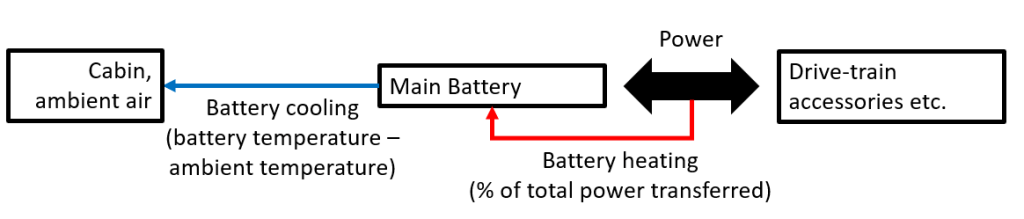
Every time you transfer power in or out of the battery, you incur resistive losses which heat your battery. More power transfer, more heat. This effect is slightly stronger at lower state of charge values, as more current is required resulting in higher resistive heat losses. Thus charging more often than strictly necessary will reduce heating for two reasons: You charge at higher voltage levels thus less current streams into the battery, and we leverage the Leafs charging system that throttles the charge speeds at higher SOC values.
Driving speed also has a sizable impact on battery heating. Generally, these things go as your speed, squared. Hence, just slowing down a little bit can make the difference between a long fast charging session and a short one. Recycling some efficiency data from an earlier post (see https://electriccaradventures.ca/2021/09/01/range-how-far-can-you-go-in-that-thing/), we can calculate the power leaving the battery as we maintain a given speed. At 140 km/hr or so, we actually reach power levels comparable to a fast charging session (40 kW), while at 90 km/hr were much closer to level 2 charging at about 15 kW, which might actually result in slight battery cooling.

Keeping the cabin cool by simply parking in the shade, using a windscreen sun-shade, and opening the windows just a crack are simple things to do. Cabin temperatures in parked cars can reach #rapidgate temperature values in about an hour (see https://globalnews.ca/news/4229911/hot-cars-temperatures-deadly-hour/). Some of that heat will wind up in the battery.
I have not run into #rapidgate personally, I did come close on a 400 km driving day in the summer as I watched the battery temperature approach the red zone after a fast charge. By simply slowing down (from 100 km/hr to 80 km/hr), I kept the battery temperature in the normal range.
 Electric car adventures
One thought on “Living with #rapidgate”