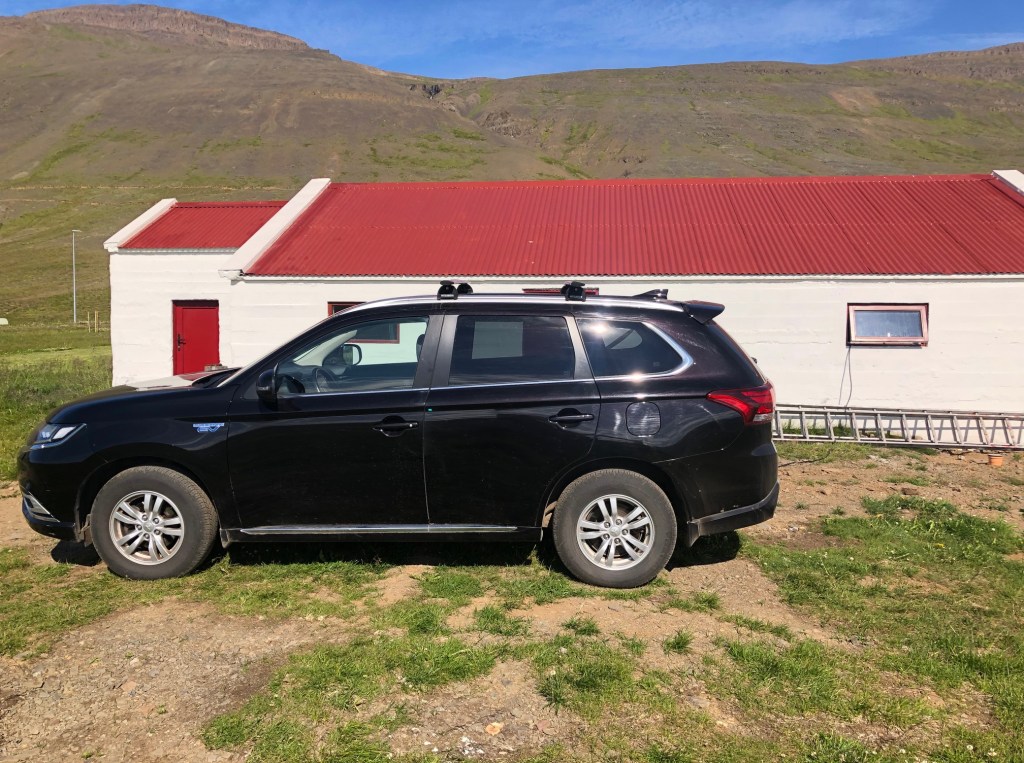
Marketed as a “plug-in-hybrid-electric-vehicle”, the Mitsubishi Outlander aims to comfort those with concerns over charging infrastructure. As a hybrid, it certainly does gets excellent gas mileage, which gets even better if you plug it in to charge. It “usually” operates as an EV for in-town jaunts, switching to gas once you leave the highway. However, as with all things hybrid, there are engineering compromises that you feel as you drive it. Further the gas engine requires gas and a fair bit of maintenance, resulting in worse operating economics compared to my 2018 Nissan Leaf. As discussed in this blog, charging infrastructure is certainly good enough for my travels all over Ontario, hence I would recommend an EV over a plug-in-hybrid any day. But as always, much depends on where and how you live.
Generally speaking, gas cars are terribly inefficient. At best, only about 30% of the energy contained in gasoline is converted to power at the wheels (source), in real life situations it gets even worse with perhaps only 15% of the energy in gasoline converted to power at the wheels. Contrast that to 77 % efficiency for electric cars converting grid-power to wheel-power. However, many are concerned over the state of charging infrastructure, or lack there of (source).
Enter the plug-in hybrid, operating on electricity when close to home (and your charging station presumably), while switching to gas on longer journeys (far from your own charging station). The hybrid drive-train can certainly remedy many issues with gas car efficiency. To begin with, one rarely uses the full horsepower of the car, hence the electric drive train can augment the gas one when say overtaking on the freeway. Next, as the electric drive-train can take care of the “peaks” of power demand, we can opt for a more efficient gas engine architecture (such as the Atkinson’s source). Like the EV, regenerative braking can capture energy otherwise wasted.

We put this to the test, starting with a full gas tank, and a full battery we did a 280 km drive. Afterwards we filled up the tank and discovered that we had consumed about 17l of gas, and the entire “displayed” battery capacity. This adds up to a fuel efficiency number of 6 l/100 km, beating the EPA numbers of the 2018 Nissan Versa (6.6 l/100 km source). Not bad, given that we actually had a 800 m climb on our route (a short highland crossing), and the EPA testing I am sure for the 2018 Nissan Versa were done with much more care for fuel efficiency, perhaps on a flat course.
The complexity of the drive-train does bring with it some quirks. For example, on our highland crossing, there came a time where the car felt very underpowered, because well, it was operating on gas only, and 100 kW for this size of a car is just not enough. Further, the gas engine provides cabin heat, hence if you turn on the heater the gas engine turns on, even if you have ample battery capacity left.
Looking at the economics, taking our 6 l/100 km efficiency figure renders a “likely” fuel cost of $ 10.8 for a 100 km trip. This compares to $ 12 for the 2018 Nissan Versa, and $ 6-9 for the Nissan Leaf. Further, maintenance wise, according to Edmond’s, Nissan Leaf is about 60% of the maintenance cost of the Mitsubishi Outlander (5 year maintenance cost of $4377 vs $7661 respectively source and source). Thus from an economics standpoint, my 2018 Leaf is the clear favorite over the 2018 Mitsubishi Outlander.
 Electric car adventures
One thought on “Driving the Mitsubishi Outlander”