As gas prices increase, interest in electric car’s has increased. But it seems you can spend more on charging than gas (source). As always, in these click-bait times, the devil lies in the details, or more specifically in the math. So lets do some math and see how much I need to pay to drive my 2018 Nissan Leaf 100 km, and for comparison a 2018 Nissan Versa. We look at about 10 different situations, while a poor use of a L3 fast charger can cost more than the Versa, generally fuel costs for the Leaf are lower than the Versa, not surprising when the Nissan Versa requires over three times the energy of the Nissan Leaf to drive said 100 km.
Lets start with how much energy I need to procure for my 100 km of driving. For my 2018 Nissan leaf the EPA reports a 30 kWh per 100 mile consumption, or 18.6 kWh per 100 km. Similarly the EPA rates the 2018 Nissan Versa at 2.9 Gallons/100 miles or 6.8 l per 100 km (source). So 18.6 kWh of electricity or 6.8 l of gas. Of note is that 6.8l of gas, apparently equate to 60.5 kWh of energy ( source), more on that in a later post, but that makes the 2018 Nissan Leaf over three times more energy efficient than the 2018 Nissan Versa.
Next we look at electricity, as is so often the case, there are lots of options for procuring said 18.6 kWh. You might be able to charge for free, for example I often use the complimentary RV power connection when camping (see this post), some employers also offer free charging for their employees, and grocery stores for their customers. Charging at home, all-in residential energy prices in the Toronto area, add to about 12 c/kWh ( source), so that’s $2.25. Getting fancy, amortizing a $2 000 charging station over say 5 years (lets assume one charge per week, and that 18.6 kWh is more like a “half-charge”) we get $6.25. A common price I have encountered for pay-as-you-go L2 charging is $2 per hour, and you would need about 3 hours to get to 18.6 kWh at 6.6 kW, so that’s $6.
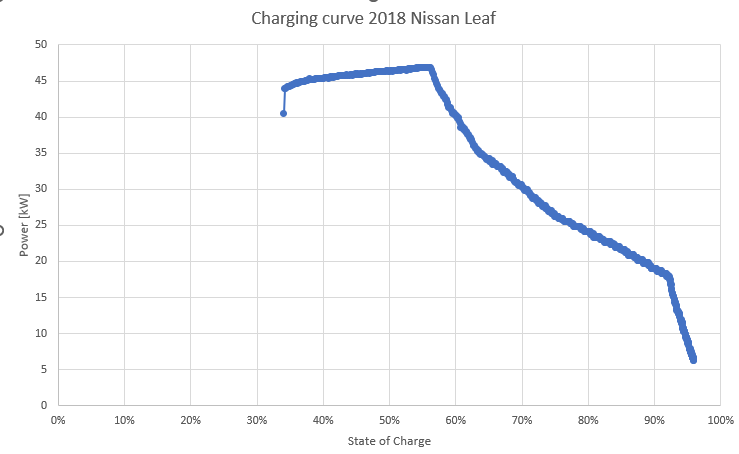
Fast charging gets a little murkier, as you typically pay perhaps $18 per hour for 50 kW max. Your car may not be able to take 50 kW for the entire hour. If it did, you would only need 22 minutes on the charger, so that’s $6.7. Looking at the charging speed curve from a recent charging session, we see that charging speed slows down to 5 kW towards the end of the session, taking that as our worst case scenario, that’s whopping $67 for the same 18.6 kWh. Do note that due to the nature of fast charging pricing, it is much more economical to start charging from nearly empty, that’s where we get that $6.7 for 100 km of driving. More realistically, Id pick 30 minutes for the L3 fast charging scenario, as you only get 5kW towards the very end, so that’s $9.
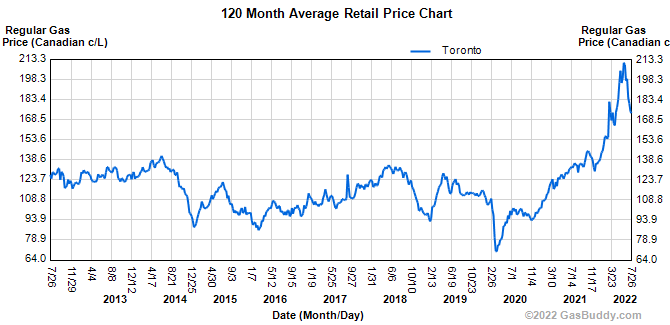
Now to gas four our comparison vehicle a 2018 Nissan Versa, GasBuddy has an excellent charting interface that we can use to look at gas-prices in Toronto and see how they have changed over time. The most expensive seems to be $2.13/l, while the cheapest is $0.64/l, thus our 6.8l will range in price from $4.35 to $14.48. Looking at recent data, $1.9/l seems more realistic, and that’s about $12.
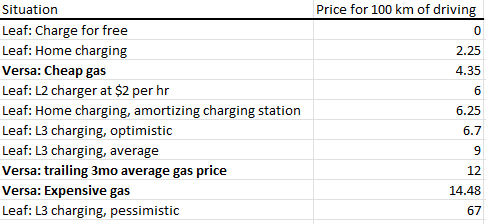
So, lets tabulate our pricing below for 100 km of driving. For the Leaf, we have a range of $0 to $67, while the Versa ranges from $4.35 to $14.48. Granted the only scenario exceeding the Versa costs are found when making a rather poor use of relatively expensive fast charging infrastructure. If one does most charging at home, using L3 fast charging only when nearly empty and stopping at 80%, the overall fuel bill is likely much higher for the Versa than the Leaf. Driving the Leaf could cost you half as much in fuel as the Versa.
As always with these things, there are many caviats. First of, I took the EPA fuel efficiency values at face value. For the Leaf, I find that driving slower can dramatically increase efficiency, getting twice the EPA efficiency seems plausible (see this post). As to the Versa, driving style will similarly impact efficiency numbers, further highway fuel efficiency test procedures allow for engine warm-up something that can significantly improve efficiency (source). All this might further tilt the economics in favor of the Leaf, but I doubt the big picture would change significantly: While it is possible to spend more money on charging than gas, using L3 charging sensibly by starting to charge when you are nearly empty, and stop charging at about 80%, ensures your EV is far cheaper to fuel than a comparable gas car. Not surprising as the Versa uses over three times the amount of energy than the Leaf does.


4 thoughts on “Cost of fuel: Electrons vs Gas?”