Electrifying Ferries is quite the trend in Europe. On this side of the pond, the Maid of the Mist recently joined the fray (source). Lets look at the feasibility of electrifying the Chi Cheemaun a car ferry that operates between Tobermory and Manitoulin Island. As with electric cars, electrifying ferries holds the promise of environmental and economic benefits. $1300 of Diesel per ferry crossing is both a lot of money and a lot of Diesel. Lets start our discussion focusing on the battery requirements, we find at a 6 MWh battery would allow for fully electric sailings. A larger battery might ease electrical loads at either port.

Before we begin, I am just a green geek that feels we ought to “take-only-what-we-need” in terms of natural resources. To actually pull this off, we would need to involve a long list of experts, from ship-builders to electric propulsion to ferry operations, not to mention the operator (Owen Sound Transportation Company), port authorities (apparently mostly federal, but some provincial) and so on. The list of people that would have to work on this project is long, and I have very little if any expertise in much of this. I have reached out to both Hydro-One (the electricity utility company in the area) and the Owen Sound Transportation Company the ferry operator. As new information arrives, Ill update the article as need be. This blog article is merely indented to inspire further discussions, that might one day lead to an electric ferry to Manitoulin Island.
Owen sound transportation company reported in their 2019 annual report, that fuel expenses for the Chi Cheemaun were about $1300 per one way crossing (source). Assuming a whole-sale price of about $1 per liter of Diesel (about 20% lower than retail sales during the 2019 sailing season source), that’s about 1300 liters of diesel per crossing. With a 10 kWh/l energy density of Diesel, and a 30% conversion efficiency from Diesel to Electricity we would need a 4 MWh battery to carry enough energy for the crossing. My assumed 30% efficiency is a little lower than the Herjolfur, which I think is fair, as Herjolfur is a new built hybrid-electric ferry which we explored in a prior post.
This gives us some idea of battery size requirements. One approach, lets call it “minimum-battery-size”, is to choose a battery just big enough to manage a crossing, relying on charging during the turn-around time in port to recharge the batteries. Lets settle on a 6 MWh battery, which would hold our 4 MWh for the crossing (plus a small reserve for windy, fully loaded crossings). Our 4 MWh per crossing could be replenished during a 30 minute turnaround at either end, which requires an 8 MW charging station. Oddly enough, the cruising industry uses such high power connections routinely, as we discussed in a prior post.
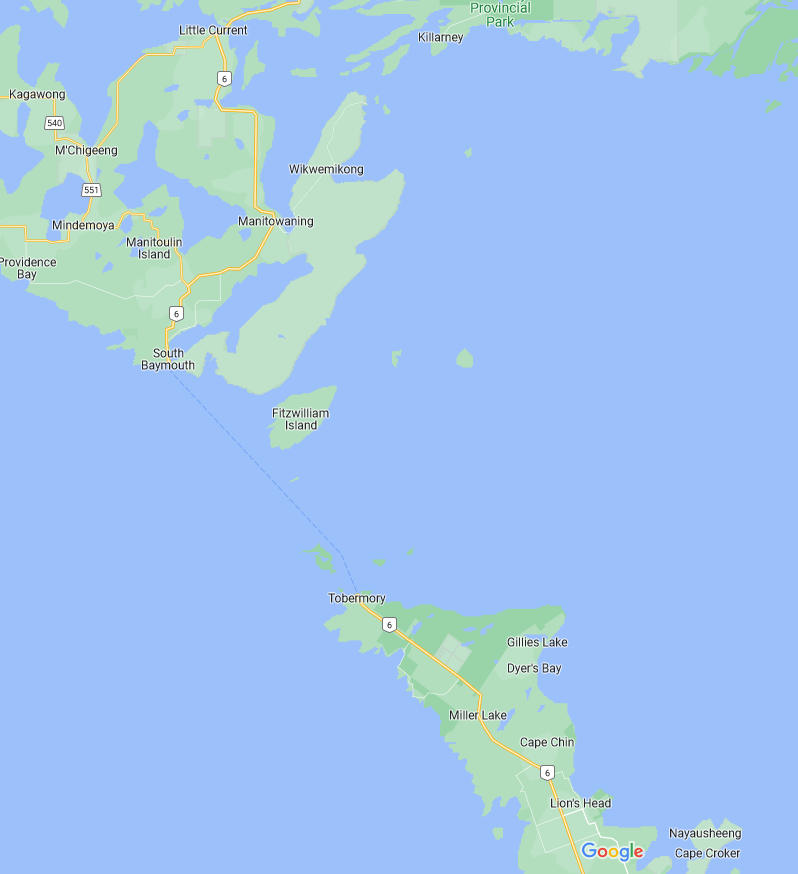
The two rural communities of Tobermory and South Baymouth, might struggle however to provide for an 8 MW ferry charger. The ferry overnights in Tobermory during the regular season. The last sailing docks in Tobermory at 10 pm, and the first sailing leaves at 9 am. We do two 30 minute turn-arounds in Tobermory which we could use, alltold 12 hours of charging per day. On a given day during peak season in the summer, we have 6 crossings scheduled, so that is a daily consumption of 24 MWh, which we can replenish during our 12 hour charging window with a 2 MW charger. Lets settle on a battery size of 27 MWh for our “minimum charging speed” scenario. That charging speed of 2 MW is a lot more manageable, particularly as we would do most of our charging between 10 pm and 9 am, which are usually low electrical demand hours.
| Parameter | “Minimum-battery size” | “Minimum-charging speed” |
| Battery size | 6 MWh | 27 MWh |
| Charging speed | 8 MW | 2 MW |
| Battery size | “two shipping containers” | “nine shipping containers” |
| Battery Weight | 60 tonnes | 270 tonnes |
| Battery Cost | ~$2 M | ~$9 M |
The table above outlines our battery requirements. For fun, we add costs, size and weight estimates based on industry figures. Tesla apparently sells a 3 MWh “mega-pack” for about $1M each (source), so that’s $2M-$9M on batteries. Also it appears that each “mega-pack” is approximately the size of a shipping container, of which we need two for the minimum battery scenario, and nine for our minimum charge speed scenario.
Weight wise, using a “pack-density” of 100 Wh/Kg (source), we arrive at a pack weight of 60 tonnes and 270 tonnes for our two batteries. Thankfully these large figures are a small fraction of the Chi-Cheemaun’s 7 000 tonne weight ( source).
In summary, we have a “minimum-battery” scenario using a 6 MWh battery, with a 8 MW charger on both Tobermory and South-Baymout, or a “minimum-charging speed” scenario with a much bigger 27 MWh battery, and a much more manageable 2 MW station in Tobermory only. We will continue to explore the idea of an electric Chi-Cheemaun in future posts, looking next at the electrical infrastructure in Tobermory and South Baymouth.
 Electric car adventures