As we discussed in a prior post, an electric Chi Cheemaun might need about 4 MWh of electricity per crossing. Replenishing this at either end during a 30 minute turnaround would require an 8 MW ferry charger installed at either end. With a larger battery, we can dramatically slow down our charging speed to perhaps 2 MW by doing the bulk of our charging overnight in Tobermory. Lets explore the feasibility of providing all that electrical power to our ferry charger. We find that the 2MW power level might be manageable based on census data and average household usage in Ontario.
I reached out to media relations at Hydro-One to query what kind of electrical connections might be possible in Tobermory. The good news is that Hydro-One is obligated to provide whatever grid connection is needed, but they can pass the cost onto the customer asking for it. To me, I feel that basically translates into “we need to make a deal”. And as such, Hydro-One while very helpful, is understandably hesitant to commit to any resemblance of a price that might hurt them in these and other ongoing negotiations. While we may not get any clear answers from Hydro-One, we can use census data, and some gooling to shed light on approximate transmission capacity into Tobermory.
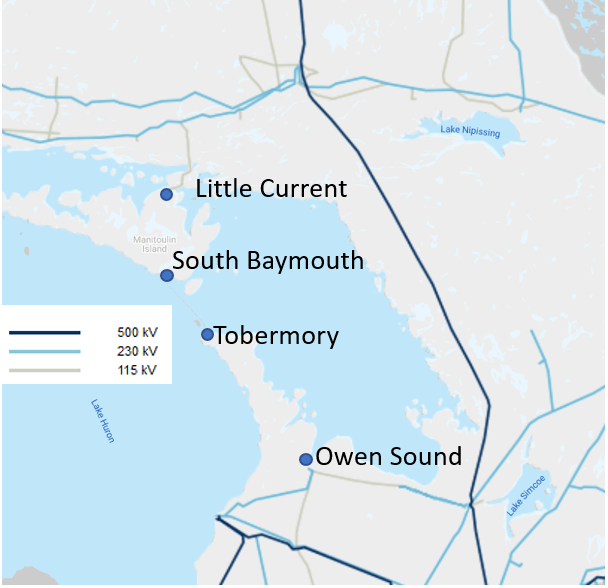
Lets start with some googling. Ontario’s independent electricity systems operator publishes maps outlining electricity infrastructure in Ontario. The image above shows high-power transmission lines which form the backbone of Ontario’s electricity transmission infrastructure ( source). The bad news is that the nearest sub-station is on Owen sound, approximately 100 km from Tobermory. A substation handles large amounts of power (Owen sound for example is anticipated to handle 100 MW of power in the summer source), our 2-8 MW ferry charger would be approximately 2-8 % of the Owen Sound’s substation’s total load, perhaps something manageable. But alas, there are approximately 100 km between Tobermory and Owen Sound, and building a transmission line between the two just for our ferry charger would seriously impact our return on investment, not to mention timeline as building a transmission line from start to finish can take years (source)
But there must be some transmission line capacity up the Bruce peninsula. After all Tobermory is part of the North Bruce Municipality which had 3850 residents back in 2011 ( source). Not all of them live in Tobermory, but there are many summer homes in the area, so lets take a guess, and say Tobermory has around 2000 homes. The average household on a hot summer day consumes perhaps 5 kW (assuming a 27 GW peak power demand in Ontario source, and 5 M households in Ontario source). This suggests that Tobermory has transmission capacity of at least 10 MW.
Similarly South Baymouth might have perhaps 300 households (source), using the same math, that suggests 1.5 MW transmission capacity into South Baymouth. Useful perhaps for a quick top-up, but the bulk of our charge for the South Baymouth to Tobermory leg must come from Tobermory it seems.
In Summary, we have at least a 10 MW power connection into Tobermory, with South Baymouth perhaps having at least 1.5 MW. At night, electricity demand falls perhaps by a third, in which case, it seems plausible Tobermory’s grid could spare perhaps 3 MW to charge our ferry, which is enables our “minimum-charging-speed” scenario, without the need to invest in a new transmission line to Owen Sound.


One thought on “Charging an electric Chi Cheemaun”