As we have extensively discussed, taking my Nissan Leaf around Ontario is no problem these days. Some planning is required, and there have been times where you have to be very careful with your speed, lest us run out of juice before the next charger. As DC fast charging starts to become more ubiquitous, thankfully, that is less of a worry. In fact charging availability is starting to open up some interesting possibilities. Is it worth stopping more often to charge and driving faster, or is the slow but steady the way to win the race? We find somewhere in between to be a sensible choice, for my 2018 Nissan Leaf, the posted speed limit along Hwy 401, 100 km/hr is a sensible choice, balancing charging and driving time.
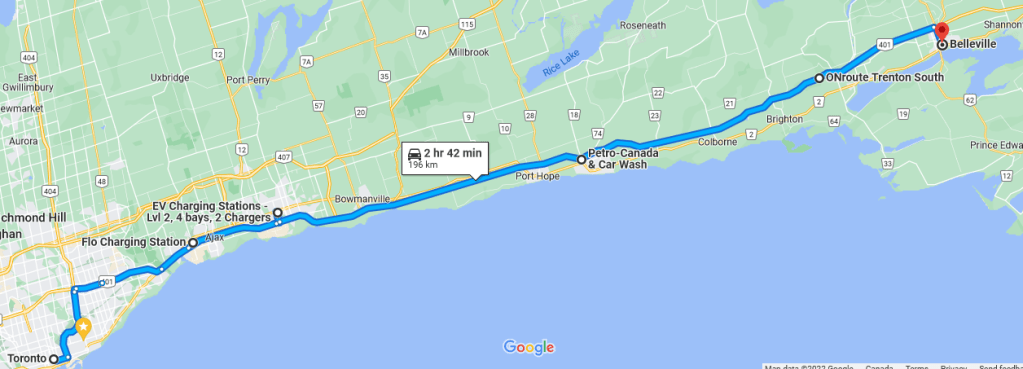
As avid readers of this blog will note, roadtripping in an EV is entirely possible, and in my opinion a lot more fun than in a gas car. Further, charging availability, at least in certain corridors, is getting to a point where you have lots of options. Gone are the days where the distance to the next charger dictated your driving speed. Consider for example, the 190 km leg from Toronto to Bellville, ON. There are at least 4 DC fast charging stations I have used along the route, and plugshare shows a few more that I have not used.
In my 2018 Nissan Leaf, I could choose to stick to the speed limit, and make it with a few percent, left on the Battery, or start hauling, but stop to fast charge. The table below outlines what happens (theoretically) at several different speeds. The efficiency numbers I got from an earlier post, and some of my experiences on this blog.
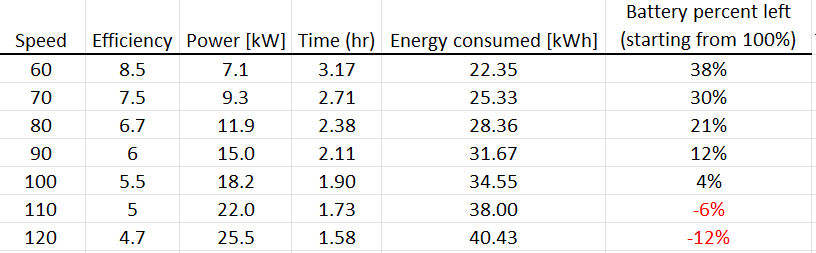
Lets call the 100km/hr our base case. That takes about 1 hr and 54 minutes. If we book it at “a buck twenty”, we now have a driving time of 1 hr and 35 minutes, but we have to stop and pick up a few kWh from any of the numerous fast chargers along the way. This might actually be quicker, as it seems possible to stop at the Ivy charger along the Trenton Onroute, where you could pick up the missing 5 kWh in about 10 minutes, arriving in Bellville, a full 9 minutes ahead of our base case.
Granted, on a 190 km leg, the difference here is mostly academic, so lets see what happens on a 400 km leg:

Perhaps it is worth adding some lead to my right foot here. Going from 1 to 2 charge stops, would allow me to drive at 100 km/hr instead of 70 km/hr, shaving about 45 minutes from my 6-7 hr drive. I do a little better at 110 km/hr, but anything faster, winds up adding time as I need an additional charge stop. Going even further (say 800km between say Toronto and Quebec City), we see a similar pattern

Here the speed-limit proves to be a good choice as charging times eventually add too much drag on our trip time.
In practice, there are a few things to add. Traffic jams in an EV do have a silver lining, namely those slower speeds sure do wonders to your efficiency, possibly saving a charge stop.
The Nissan Leaf lacks active battery cooling, which can be a problem on longer journeys as the car has no alternative but to slow down charging speeds to keep battery temperatures manageable. In the 800 km trip table, I took some account for this, using a slower “average-charge-speed” of 20 kW, than in the other tables (I used 27 kW in the 400 km, and 35 kW in the 190 km table).
The “charging-curve” is another consideration. EV’s give you the fastest charging speed, over a relatively limited range of “state-of-charge”. For most brands, its not worth charging much above 80 %, as charging speeds throttle down significantly at that point. For example in my 2018 Nissan Leaf, at 80 % state of charge, I’m at about half of the rated charge speed, which throttles down to 6 kw, by the time I get to 95% state of charge.
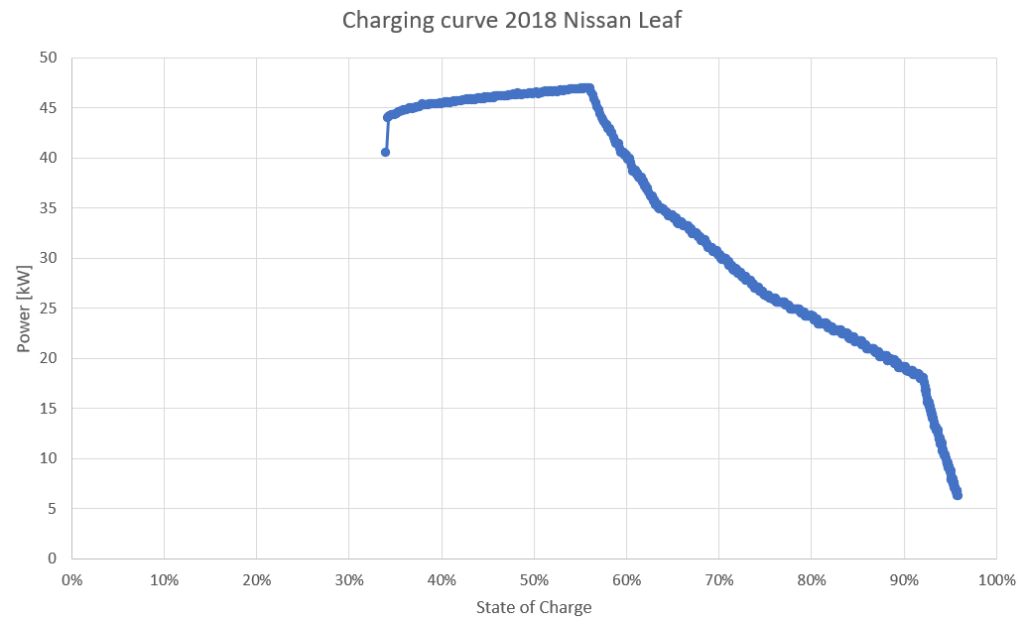
Thus, choosing when to charge is another point. For example, in our 190 km Toronto to Bellville route discussed above, in our more eh, lead-footed scenarios, it would be better to stop at the Trenton Onroute than the Pickering Flo charger, mostly because your state-of-charge in Pickering is likely going to be too high (about 80-90 % would be my guess) to allow for the assumed 35 kW average charge speed.
The kids in the back also have their own needs. There have been countless times when my inner mathematician has cringed at an eh, inefficient stop strategy, as the kids got hungry. But that is life, and anyways, why not try an interesting restaurant and check out a charger at the same time.
 Electric car adventures
One thought on “The optimum road trip speed”