Recently, we installed a home battery system in our home. We had several reasons for this, but a combination of economics and energy-security had us looking for a home battery system. With the system in, we take a look at Toronto Hydro’s monitoring portal (which is actually really good), and see how things are shaping up on the economics end. We find that our peak usage is entirely covered by the home battery, and it has managed to cover perhaps half of our mid-day use, this leads to about 30% reduction in cost per kWh.
Home battery systems have broadly speaking two benefits: Energy security, and some reduction in your electric bill. If there is an outage, then the home battery system kicks in and powers the whole home for several hours. Depending on the charge level, this could be anywhere from 3-12 hours in our case. As we are on the ultra-low overnight rate, its a lot cheaper to charge the battery during the night, then use the battery during peak hours. Further savings can be had by displacing some usage during regular daytime rates.
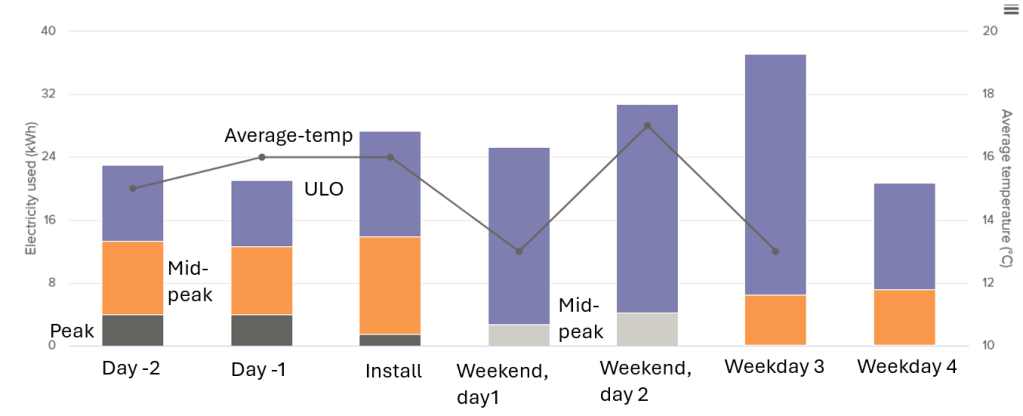
So we log into the Toronto Hydro usage portal and have a peak. Indeed, we note that we are no longer using the grid during peak hours, and have managed to replace some daytime usage as well. This suggests that our electricity charges might have gone from $2-3 per day, down to $1-2 per day.
Lets have a look at my latest power bill. Briefly, the battery was installed on day 3 of the billing cycle. The month before, I paid $120 on electricity, while the first month post install, is $140. Wait so the power-bill went up? Well, not so fast, we need to look more closely at the usage section of the bill. As we are heading into fall, and I use my heat-pump for heating, the air got a little crisper, and with it heating and usage went up. Way up, as it happens, that $120 bought 750 kWh, while that $140 bought 1170, so overall cost per kWh went from 16 c/kWh to 12 c/kWh with the home battery, savings of 25%.
But it gets a little murkier, and we need to dive a bit deeper into the power-bill to see where these savings came from. As we are on the ultra-low overnight rate, we have four time periods (source): Overnight at 3 c/Kwh, On-Peak 4pm-7pm weekdays at 30 c/kWh, Mid-Peak 7am-4pm, and 9pm-11pm weekdays at 13 c/kWh, and off-peak weekends 7 am to 11 pm at 8 c/kWh. Note there is also a transmission charge of 2.5 c/kWh, which we add to these figures. Looking at my usage, with the battery, the overnight portion has grown from 53% to 71%, the on-peak has shrunk down to only 1%, with mid-peak and off-peak shrinking slightly.
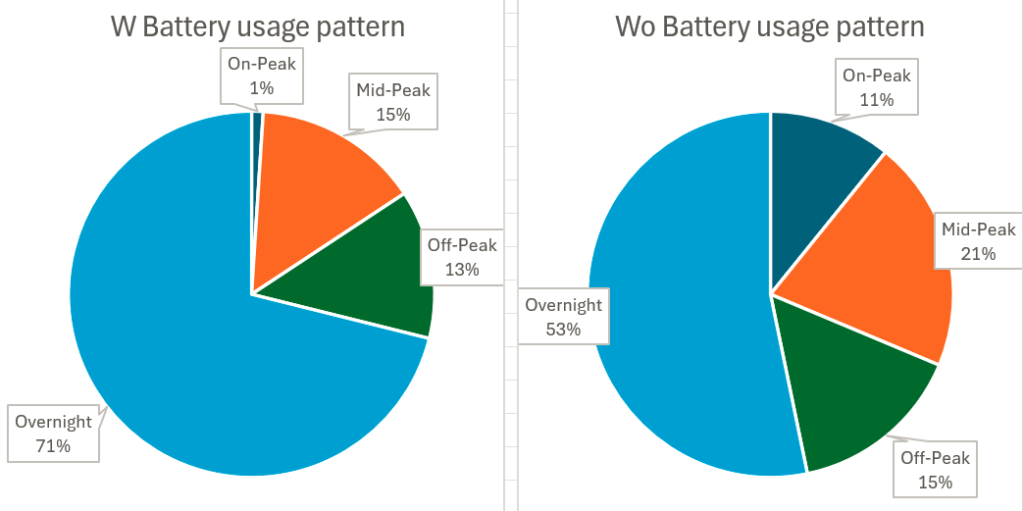
When factoring in the costs, we have gone from 11 c/kWh to 8 c/kWh, which is a 30% reduction in cost per kWh purchased. Not bad, as it translates to yearly savings of about $320/year, admittedly factoring in the 25k purchase price, over a 30 year system life, we would recoup about half of our investment in cost savings from the power-bill, which is what we expected.
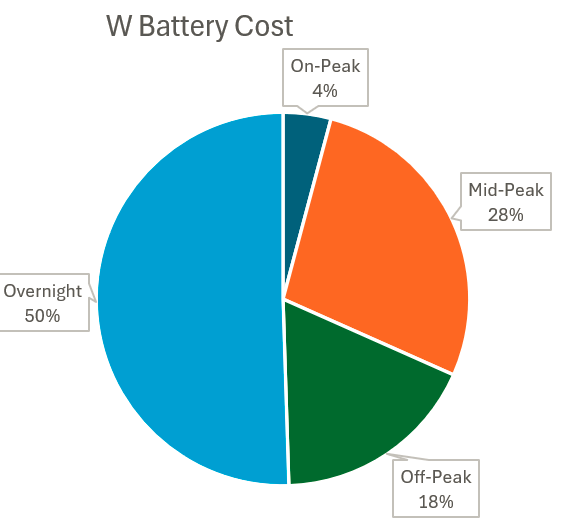
Lets look at the costs a bit further, we see in the graph below that the ultra-low overnight is about half of what we spend on the usage portion of our power-bill. The other half, is mostly daytime usage, be it on the weekend or weekdays. There is still a small on-peak portion, mostly as the install was a few days into the billing cycle, but also as a few kWh are bound to be needed during peak, even while the house is operating on the battery for various reasons.
With that, I expect solar to be a better choice for us moving forward. As it would have the additional benefit of offsetting some of my overnight charges. After all, a kWh exported during the day, can be exchanged for two or three kWh during the night.

